This blog is authored by Quentin Wodon, Director of UNESCO's International Institute for Capacity Building in Africa (IICBA).
Sharing experiences from good practices in teacher professional development and broader teacher policies is a priority shared by many organizations in Africa. In early 2025, five such organizations combined forces to organize a new, open access monthly webinar series – the Africa Teachers Webinar Series (registration is free here). Recordings of the webinars and the PowerPoint presentations used by speakers are made available after the webinars at https://www.iicba.unesco.org/en/webinars-events.
The five organizations co-sponsoring the webinar series are, alphabetically, (1) the Africa Federation of Teacher Regulatory Authorities, (2) the African Union represented by its Education, Science, Technology, and Innovation Department, (3) the European Union through its Regional Teachers Initiative for Africa, (4) the Global Partnership for Education through its Knowledge and Innovation Exchange (KIX), a joint endeavor with the International Development Research Centre, Canada, and finally (5) UNESCO International Institute for Capacity Building in Africa (IICBA), whose staff lead the webinar series and work closely with each of the other organizations, including by managing the Africa 19 Hub for KIX with a focus on anglophone African countries.
The webinar series is organized in blocks of three sessions on specific themes, with experts, researchers, and practitioners sharing promising practices, useful resources and frameworks, and practical strategies. In 2025, the first block of three webinars focused on issues related to the continuous professional development (CPD) of teachers in Africa. The second block of three webinar focused on issues related to the new Continental Education Strategy for Africa 2026-2035 adopted by the African Union. The third block again with three webinars focused on education for health and well-being.
What have we learned so far?
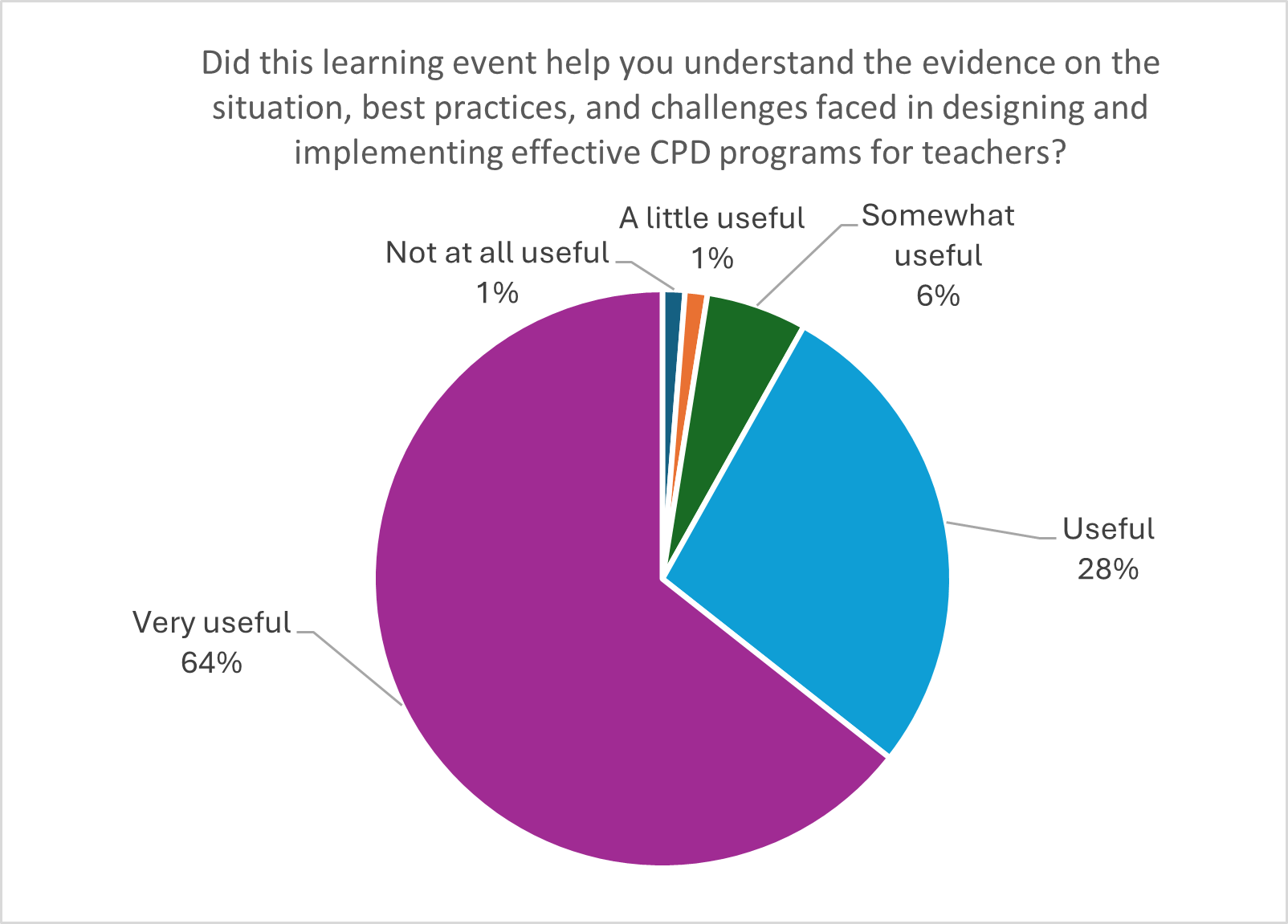
Nine webinars were organized in 2025 with a total of about 2,800 participants for the year (including about 300 participants in person for two webinars that were hybrid). After each webinar, a short evaluation survey is sent to participants. As an illustration of results, responses after the first webinar on teacher continuous professional development (CPD) are tabulated in the Figures below. Most participants found that webinar useful to understand the evidence on the situation, best practices, and challenges faced in designing and implementing effective CPD programs. Participants also suggest that the webinar met their expectations. These results are encouraging, and similar findings have been observed for the other webinars organized in 2025.

There are also some areas for improvement. Translation is provided in English, French, and Portuguese for all webinars. Yet most participants come from anglophone countries, and very few are from Portuguese-speaking countries. The countries with high participation rates include Nigeria, Uganda, Ethiopia, Lesotho, Kenya, Rwanda, Ghana, Zambia, with Côte d’Ivoire being the only francophone countries appearing as a a top 5 country for the number of participants in some of the webinars. Clearly, additional efforts are needed to better reach francophone and Portuguese stakeholders. On the other hand, there is gender balance among participants, with almost exactly half being men, and half women. There is also a good mix between education officers, teachers, and others. Many participants join all three webinars in any given sub-series, even if some prefer to attend only one or two of the webinars in a sub-series.
Participants also gave us feedback through open-ended questions in the satisfaction surveys. They appreciate practical, localized case studies that help connect theory to classroom realities. This is why each webinar includes a short keynote, a main presentation, and three case studies. Although Zoom sends reminders to those who have registered, participants appreciate more reminders prior to webinars. They also appreciate interactions through Q&As. Some participants suggested adding more young people or even students as speakers. As to topics of interest, many suggestions were made, including peace education, higher education, inclusive education in large classrooms, digital technologies in areas without connectivity, AI-related teaching and learning, ICT integration in teaching and learning, teacher training in marginalized contexts, safe learning environments, ECE curriculum, violence in school, integration of health and well-being into lesson delivery, and school leadership (this list is not exhaustive).
Webinars are typically organized on a Thursday at 3 pm East African Time (GMT+3). In 2026, the first set of three webinars will focus on issues related to the potential of digital skills and AI to improve educational outcomes in Africa. The first webinar on Digitalization and AI in Higher Education: From Strategy to Practice will take place at 3 pm EAT on Thursday, February 26, 2026. The second webinar on Leveraging e-Learning for Teacher Professional Development: Lifelong Learning Opportunities will take place at 3 pm EAT on Thursday, March 26, 2026. The third webinar on Defining and Measuring Digital and AI Competencies: Frameworks for Educators and Institutions will take place at 3 pm EAT on Thursday April 23, 2026. If you have ideas of presenters for the second and third webinars, please let us know at info.iicb@unesco.org as we have not yet finalized the agenda for those two webinars.
The next series of three webinars will focus on education in emergencies, and how to strengthen teacher recruitment, professional development, and retention in such contexts. Key topics will include ensuring that children and youth who are refugees or displaced receive the education they deserve, while also recognizing the qualifications of teachers who may themselves be refugees and ensuring that teacher professional development is adapted to emergency contexts. Again, if you have ideas for presenters, do not hesitate to send us an email at info.iicba@unesco.org. And if you are interested in our webinar series, please register for future webinars at https://www.iicba.unesco.org/en/webinars-events. Together, let’s draw inspiration from the insights shared at the webinars and apply our knowledge to strengthen teaching and learning in Africa and beyond!

Related links & resources
- Africa Teachers Webinar Series
- UNESCO IICBA
- Global Report on Teachers
- Teacher Professional Development Guide
- Regional Teachers’ Initiative for Africa (RTIA)
Image credit: UNESCO/Emily Pinna
