Our 2025 wrapped: Reflecting on the TTF’s impact for teachers
2025 marked a year full of engaging opportunities, fruitful discussions, and productive advancements towards achieving SDG 4 target 4.c through the work of the Teacher Task Force (TTF), especially amid ever-changing geopolitical shifts. Activities in 2025 continued to be structured around knowledge production and dissemination, advocacy, and national and regional policy learning, marking the final year of our 2022-2025 Strategic Plan.
Month to month, the TTF raised awareness and expanded knowledge across key issues concerning teachers: from building AI competencies to promoting collaboration to advocating for greater financing of the teaching profession.
Moving with the same momentum into 2026 and beginning of a new Strategic Plan cycle, the TTF enters another year full of meaningful dialogue, reflection and stocktaking around innovative policies, and global action aimed at improving teachers’ working conditions, education and well-being. As the year comes to an end, it is important to reflect on the accomplishments from 2025 that will set the pace for the upcoming year.
Global efforts propelling the teaching agenda
The TTF participated in dozens of global events prioritizing sustainable teacher development initiatives, ultimately leading to one of the largest initiatives of the year, the World Summit on Teachers in Santiago de Chile. Building on the 2024 Global Report on Teachers (GRT) and the 14th Policy Dialogue Forum (PDF), the Summit culminated in the adoption of the Santiago Consensus, which was developed collaboratively under the auspices of UNESCO and the TTF, the SDG4-Education 2030 High-Level Steering Committee, youth networks, teachers and organizations. At its core, the Santiago Consensus underscores the indispensable role of teachers in education systems worldwide and recognizes the key role that the TTF plays and should play in fostering teacher policy development and implementation.

Youth engagement formed part of the TTF’s wider advocacy and partnership work in 2025. Collaboration with the SDG4 Youth & Student Network supported dialogue around the Santiago Consensus and broader global exchanges on addressing teacher shortages and transforming the profession into one that is respected and empowered.
World Teachers’ Day served as another successful opportunity to advocate for teachers. This year’s theme, “Recasting teaching as a collaborative profession,” illustrated the significance of collaboration among teachers, an invaluable facet that will characterize the profession moving forward. The 2025 World Teachers’ Day fact sheet sheds more light on ever-evolving trends in the teaching profession and examines how to cultivate collective thinking.
Informing policy creation through knowledge products and reports
The vast knowledge produced by the network continued to spearhead advocacy campaigns and played an influential role in informing political decisions aimed at improving teacher conditions, beginning with further dissemination of the 2024 Global Report on Teachers. The TTF successfully launched the Portuguese version of the report in Brasília and the Spanish version through three national launches in Madrid, Seville and Valencia, as well as a regional launch in Chile for Latin America, strengthening advocacy efforts at both regional and national level. In parallel, work advanced on the forthcoming 2026 edition through Editorial Board meetings.
New evidence also emerged this year, such as Costing and financing the teaching profession: A strategic investment in education, a paper offering strategic guidance for governments and education stakeholders on funding the profession. Promoting and protecting teacher agency in the age of artificial intelligence and its quick guide are that support understanding of major advances in artificial intelligence (AI) and how these can be adapted to teachers’ needs. Both papers set the course for the future of the education agenda, highlighting strategies to finance the teaching profession and analyzing the role of AI in classrooms.

Developed in line with World Teachers’ Day 2025, the World Teachers’ Day fact sheet, published by the TTF and UNESCO Institute for Statistics (UIS), highlights new trends and data related to the teaching profession and how these insights can support continuous professional development.
The TTF further contributed to knowledge generation through its participation in the APPRENDRE international seminar in Dakar in October 2025, where the Secretariat shared key highlights from a forthcoming paper on Teacher Management Information Systems (TMIS) in sub-Saharan Africa, underscoring the role of reliable teacher data in supporting effective planning and evidence-based policymaking.
Continuing to advocate for inclusive education
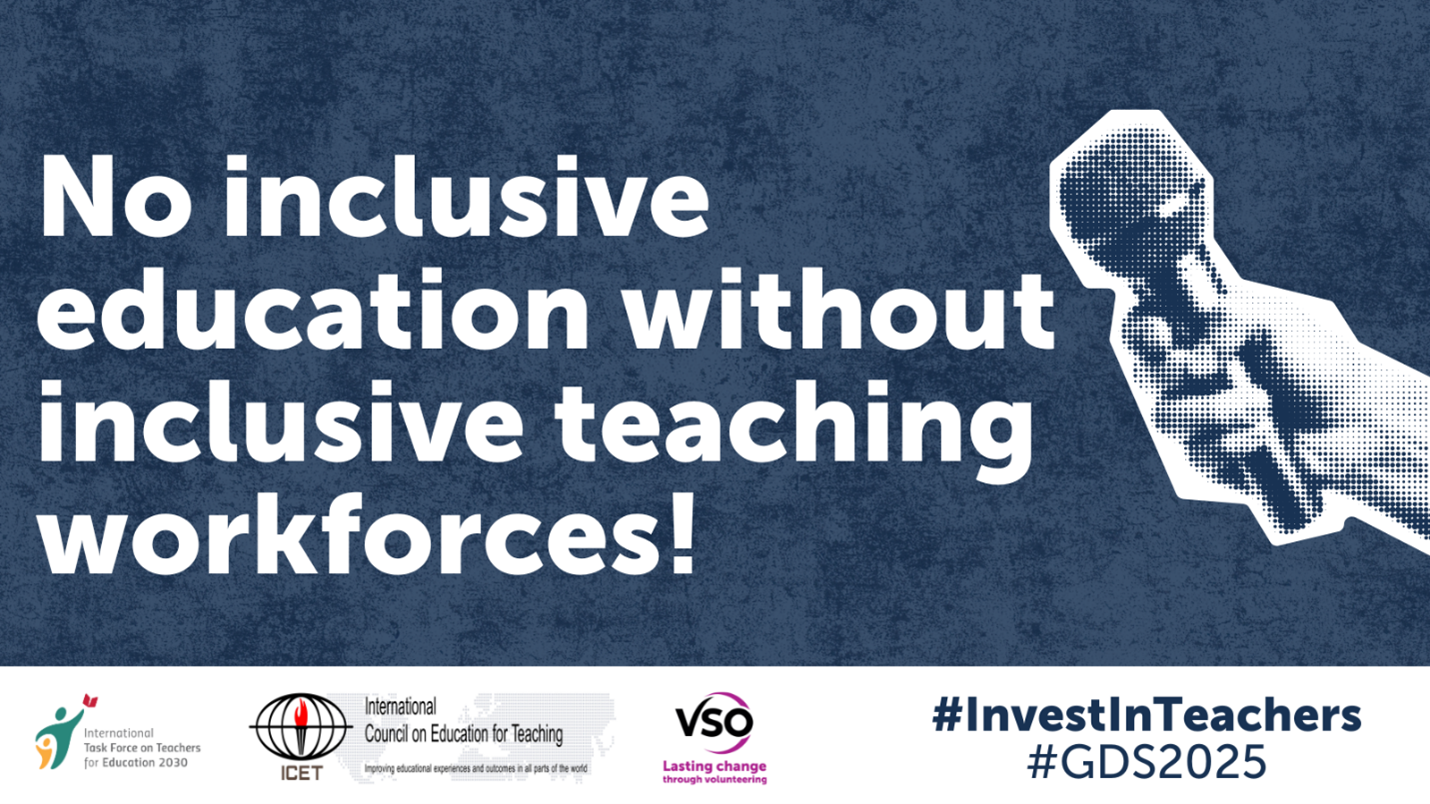
Inclusive education was a major theme in the work of the TTF this year, playing a part in multiple events, such as the Global Disability Summit and International Day of Persons with Disabilities. The advocacy campaign Teachers without limits: Voices we must hear, leaders we must follow, led by the TTF’s Thematic Group on Inclusion and Equity in Teacher Policies and Practices, exemplified member-led collaboration by amplifying the leadership and lived experiences of teachers with disabilities through blogs, interviews and social media.
In parallel, the TTF continued its engagement in youth-led advocacy around the Santiago Consensus, ensuring sustained attention to its core messages on inclusive and equitable education.
Supporting teacher policies at a national and regional level
The Teacher Policy Development Guide (TPDG) continued to support evidence-informed teacher policies, helping ensure that every learner is taught by qualified, trained and well-supported teachers. Regional webinars included a policy learning webinar in the Asia-Pacific region, co-organized with INRULED, focused on rural teacher policies and lessons from implementation, as well as a regional webinar for Arab States – facilitated by RCQE – on the costing and financing of teacher policies, with insights feeding into the development of new TPDG modules.
Looking ahead at 2026
With all the transformative work from 2025 paving the way, the year ahead will continue to foster inclusive, equitable, and quality opportunities for teachers through policy dialogues, reports, advocacy campaigns, and global events. Major milestones will include the release of the 2026-2029 Strategic Plan and the next edition of the Global Report on Teachers, as well as ongoing dissemination and contextualization of the Santiago Consensus.
The TTF offers a warm thank you to its members and partners for their collaboration and unwavering support towards realizing SDG 4. As we embark on a new year, it is critical to recognize the contributions of the network and commitment to bettering the teaching profession.
To learn more about the many accomplishments of the TTF and its members this past year, explore our blogs and subscribe to our newsletter.
2026 upcoming highlights:
- The next edition of the Global Report on Teachers, highlighting professional development and lifelong learning for educators;
- The release of the 2026-2029 TTF Strategic Plan;
- Continuation of the #TeachersMissing campaign with a focus on Sub-Saharan Africa;
- The 15th Teacher Policy Dialogue Forum hosted by Saudi Arabia;
- Ongoing dissemination of the Santiago Consensus.