Blog
  • 26.05.2026

Teacher training in resource-constrained and crisis-affected contexts

This blog has been co-authored by April Williamson, Director of Global Projects, Digital Promise, and Prof. Sarah Younie, CEO, MESHGuides, co-leads of the Teacher Task Force Thematic Group on Digital Education and Artificial Intelligence.


Global education systems are undergoing rapid, but uneven, digital transformations. Increasingly, teaching and learning are moving toward blended environments that embed digital technologies. Yet, a stark global reality remains: many teachers are not yet adequately prepared or supported to teach using these modalities. 

This gap is most severely felt in resource-constrained and crisis-affected settings, where uneven infrastructure, lack of consistent internet access, and unreliable electricity fundamentally disrupt the educational ecosystem. These challenges exacerbate existing pressures due to teacher shortages, school disruptions, and the psychosocial impacts of conflicts.

The Teacher Task Force (TTF) thematic group on Digital Education and AI, co-led by Digital Promise and MESHGuides, hosted a webinar showcasing how TTF members are addressing these challenges using innovative, low-tech approaches. The webinar featured insights from the European Training Foundation (ETF), Save the Children, Jokkolabs, and the British Council. The session, which built on a prior webinar in the series, highlighted strategies to ensure teaching and learning continuity in fragile settings, online and offline approaches, chatbot-based training models, and community-based and trauma-informed practices.

Teacher Task Force Member Spotlights

Gaza (ETF)

Saida Affouneh shared strategies for maintaining teaching and learning continuity in Gaza through emergency online learning models tailored for conflict zones. The intervention demonstrated that under extreme conditions, familiar, low-bandwidth tools like WhatsApp audio and text messages act as a vital tool for delivering pedagogical content and mental health and psychosocial support. Ultimately, teachers need agency to make pedagogical adaptations and practical and ethical choices in response to crises. 

Somalia (Save the Children)

Hannah Walker presented the NORAD Teacher Professional Development Programme, which integrated structured WhatsApp groups to provide continuous professional development to teachers. The key takeaway is that low-tech tools cannot succeed in a vacuum; lowering adoption barriers depends on leveraging daily-use platforms alongside active facilitation, mentoring, and dedicated coaching. 

The Gambia (Jokkolabs)

Poncelet Ileleji showcased a delivery model that leverages ChatGPT to generate curriculum-aligned lesson plans distributed via offline channels like print and community radio to rural schools. The program proves that generative AI can serve as a viable low-tech frontier through a "single connected device" model, provided outputs are vetted by humans to mitigate errors and biases. 

Ukraine (British Council)

Neenaz Ichaporia highlighted the 'Teaching English in the New Context' course, a programmatic intervention supporting displaced Ukrainian educators through an online learning environment. The research revealed that while digital networks offer critical psychosocial support, future crisis-responsive models must actively ease structural inequalities—such as the unpaid labor burdens carried by female teachers—by relying on flexible, "flipped" learning models supported by human e-moderators, rather than rigid self-access designs. 

Key Takeaways

These diverse case studies demonstrate that to create meaningful impact in resource-constrained and crisis-affected environments, the goal must be appropriate technology rather than advanced or digitally sophisticated technology. Technology improves learning outcomes only when it is deeply integrated into pedagogy and tailored to local contexts and constraints. When paired with strong human support systems, localized low-tech solutions—such as mobile messaging apps, offline digital kiosks, radio broadcasts, and printed materials—successfully bridge the infrastructure gap. Ultimately, high-impact teacher professional development requires an intentional alignment between accessible tools, effective teaching practices, and supportive institutional and ethical frameworks.

Resources

European Training Foundation (ETF)

Save the Children

Jokkolabs

British Council

PhotoStudents listen to their teacher during class at as school run by the Abdi Hawa Center in the Afgoye corridor of Somalia. Photo credit: UN Photo/Tobin Jones.
Event
  • 23.04.2026

4th Africa Teachers Webinar Series: Preparing teachers for AI-enabled classrooms

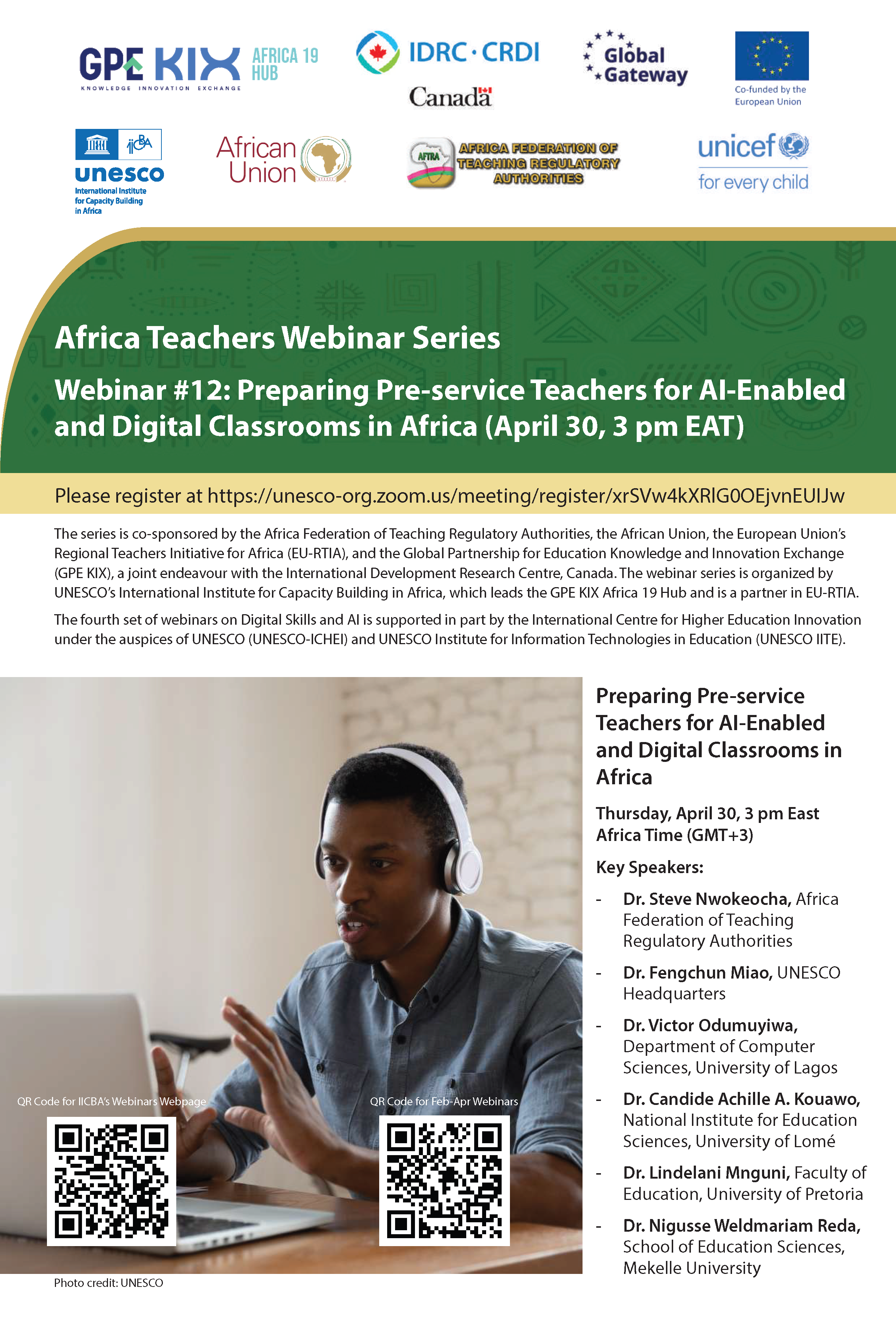
The Africa Teachers Webinar Series continues with its 12th webinar, part of the fourth set of webinars focused on digital skills and AI, reflecting an ongoing exchange on how to strengthen teaching across the continent.

Organized by UNESCO’s International Institute for Capacity Building in Africa (IICBA) with regional and global partners, the series highlights how teachers are adapting to digital transformation and the growing role of AI in education.

Webinar #12: Preparing Pre-service Teachers for AI-Enabled and Digital Classrooms in Africa will take place on:

  • 30 April, 3:00 PM EAT (GMT+3)

The session will explore how teacher education programmes can better equip future teachers with digital and AI-related competencies—supporting them to adapt pedagogy, use technology effectively, and respond to rapidly evolving classroom environments.

👉 Register: https://unesco-org.zoom.us/meeting/register/xrSVw4kXRlG0OEjvnEUIJw


Event
  • 23.04.2026

4th Africa Teachers Webinar Series: Preparing teachers for AI-enabled classrooms

The Africa Teachers Webinar Series continues with its 12th webinar, part of the fourth set of webinars focused on digital skills and AI, reflecting an ongoing exchange on how to strengthen teaching across the continent.

Organized by UNESCO’s International Institute for Capacity Building in Africa (IICBA) with regional and global partners, the series highlights how teachers are adapting to digital transformation and the growing role of AI in education.

Webinar #12: Preparing Pre-service Teachers for AI-Enabled and Digital Classrooms in Africa will take place on:

  • 30 April, 3:00 PM EAT (GMT+3)

The session will explore how teacher education programmes can better equip future teachers with digital and AI-related competencies—supporting them to adapt pedagogy, use technology effectively, and respond to rapidly evolving classroom environments.

👉 Register: https://unesco-org.zoom.us/meeting/register/xrSVw4kXRlG0OEjvnEUIJw


Blog
  • 23.04.2026

Low-tech, high impact: training teachers where they are

This blog has been co-authored by Prof. Sarah Younie, CEO, MESHGuides, and April Williamson, Director of Global Projects, Digital Promise, co-leads of the Teacher Task Force Thematic Group on Digital Education and Artificial Intelligence.


Teachers are at the heart of every education system, but in many parts of the world, they lack access to quality training and professional development. According to UNESCO and the Teacher Task Force, an estimated 44 million new teachers will be needed by 2030 to achieve the SDG 4 targets. Addressing this global teacher shortage requires a holistic approach, including training and accreditation systems that build professionalism and effectively support and develop teachers throughout their careers. Yet in many contexts — particularly those affected by crisis, limited infrastructure, and scarce resources — conventional training models fail to reach those who need them most.

The COVID-19 pandemic further highlighted the urgent need to equip large numbers of teachers with both foundational and 21st-century skills that are critical for lifelong learning and resilient societies. Teachers must be qualified, supported, and motivated — not only to provide quality teaching today, but also to prepare students for inclusive and increasingly digital societies. This is especially urgent in low- and middle-income countries, where scalable, low-cost, and rapidly deployable solutions are needed to meet the need for large-scale, high-quality, and effective training.

In this context, low-tech and mobile approaches — such as messenger-based training — are proving to be both relevant and cost-effective. Designed to function on basic phones with minimal bandwidth, these tools offer flexible, scalable, and accessible learning opportunities that meet teachers where they are. By leveraging tools that are already used by teachers, low-tech solutions can minimize, and even reduce, workload.

A number of members of the International Task Force on Teachers for Education 2030 (Teacher Task Force, or TTF) have been at the forefront of implementing such approaches. The TTF Thematic Group on Digital Education and AI, co-led by MeshGuides and Digital Promise, hosted a webinar, “Low-Tech, High Impact: Training Teachers Where They Are”, to highlight perspectives and lessons learned from two of these scalable, mobile-based teacher training solutions: the Future Teacher Kit and ProFuturo.


Mobile-based Teacher Training: Future Teacher Kit 

The Future Teacher Kit (FTK) is a mobile-based training approach tailored to reach teachers in a range of settings, including remote and crisis-affected areas. On behalf of the German Federal Ministry for Economic Cooperation and Development (BMZ), GIZ (Deutsche Gesellschaft für Internationale Zusammenarbeit) developed the Future Teacher Kit in collaboration with UNESCO and more than 1,500 teachers. The webinar highlighted perspectives on FTK implementation and impact from the Ministry of Education of Ecuador and the Jamaica Teaching Council, as well as GIZ, UNICEF and UNESCO.
 

“We know today that education systems owe teachers – not the other way around.” - Eilean von Lautz-Cauzanet, GIZ


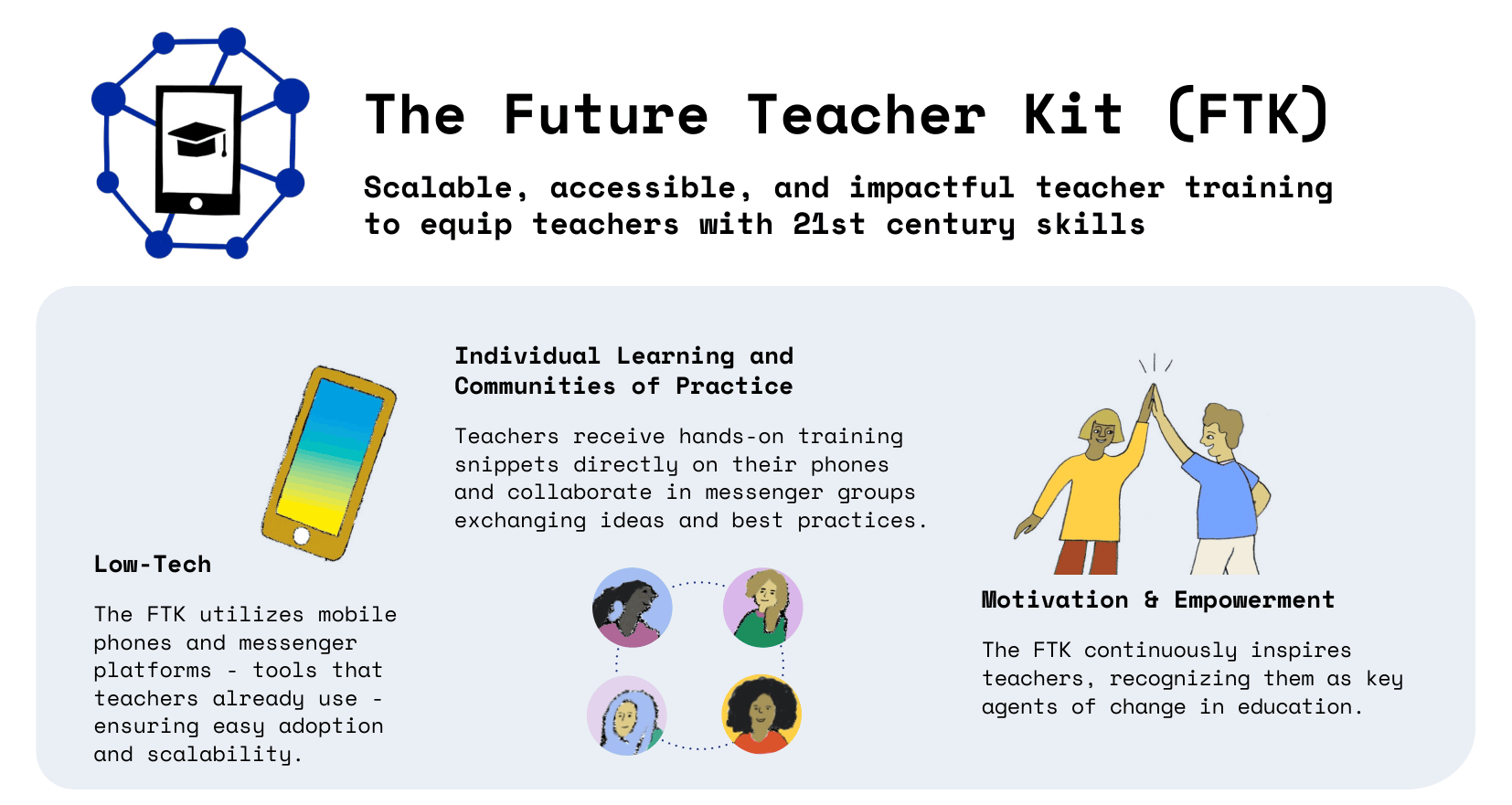
The FTK is an adaptive, scalable professional development solution designed to prepare educators for a rapidly evolving educational landscape by improving access, fostering communities of practice, and supporting education system resilience. It uses low-tech tools with high impact, such as messenger services, to reach teachers in low-connectivity areas. Through ambassador-led, participatory communities of practice, it promotes collaboration, intrinsic motivation, and self-paced learning, while strengthening teacher networks and institutional capacity. 
 

FTK
 Key characteristics of the Future Teacher Kit’s approach to ensuring scalable, accessible, and impactful teacher training.


UNICEF joined the FTK partnership in 2024, contributing its strong expertise in digital teacher development. UNICEF has developed the Superstar Teacher Toolbox, a tool to support educators to use mobile messaging for learning, including two practical guides on digital skills and mobile pedagogy. Its content has been integrated into the FTK, leveraging the UNICEF RapidPro platform for text-based delivery. This partnership is enhancing the FTK’s scalability and pedagogical quality. 
 

“The Future Teacher Kit reignited my love for teaching. It reminded me that I could grow, even in a digital world. It wasn't just training—it was transformation.” - FTK Cohort Participant 


Competency-based Digital Skills Training: ProFuturo 

As a leader in digital teacher training, ProFuturo shared complementary experiences and practical lessons from their work in low-resource contexts. ProFuturo is an education innovation programme based on technology, founded in 2016 by Telefonica Foundation and “La Caixa” Foundation. 

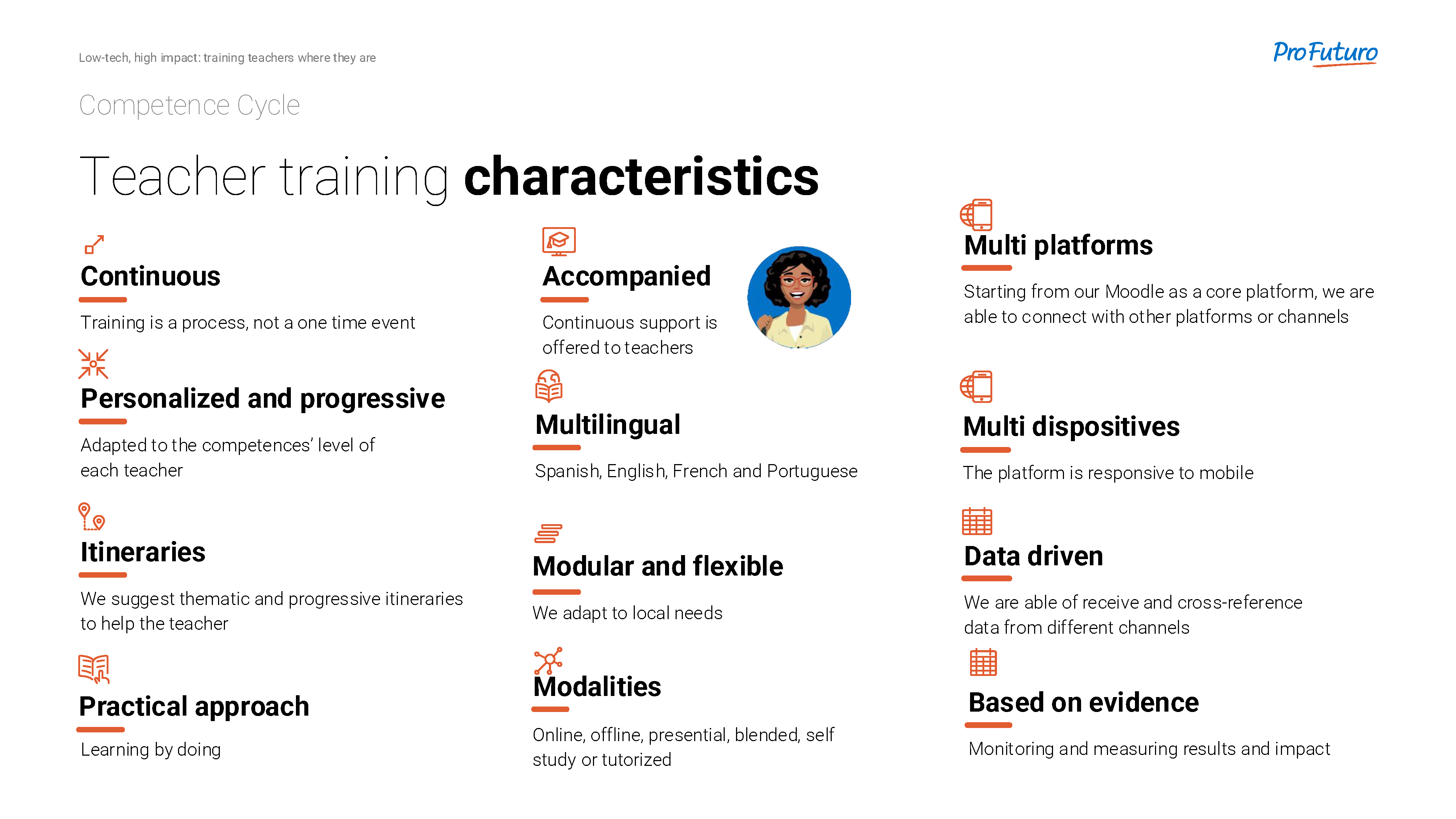
Learning and teaching are two essential processes in today’s society. To address them holistically, ProFuturo has developed the Global Framework for Educational Competence in the Digital Era. This framework supports lifelong learning, especially for teachers, and invites the educational community to reflect on the meaning of learning and teaching in the digital age, and on the teacher’s pivotal role in both. Their teacher training approach is based on an ongoing competence cycle that involves:

  1. Measurement to understand teachers’ competences, through tools like the Self-Assessment of Digital Skills for Teachers.
  2. Training that is continuous, flexible, progressive, and practical, to reduce skills gaps and empower teachers. 
  3. Practice, with access to a broad catalogue of online and offline educational resources for classroom use. 
     
ProFuturo
Key characteristics of ProFuturo’s approach to teacher training.


Through implementing their solutions with 1.8 million teachers in 30 countries, ProFuturo has identified a number of key lessons. Educational change is a cultural and systemic process centered on teachers, making their training essential for improving quality. This focus on teachers ensures high-quality training delivery, while flexibility and preparedness allow effective responses to diverse situations and challenges. 

Recognizing limits and managing expectations, alongside sustaining continuous innovation and strong collaboration, allow organizations like ProFuturo to address the complexity of training teachers across extremely diverse contexts. 
 

“Strategic partnerships enable the sharing of resources and expertise, ensuring that the program is well-supported and aligned with global educational initiatives” - Mila Tonarelli, ProFuturo


Key Takeaways and Next Steps

After the webinar, participants were surveyed to gather perspectives on teacher training strategies and needs in their own contexts. The following common themes emerged: 

  1. Teachers of the future will need to be digitally fluent, adaptable lifelong learners who foster student well-being, communicate effectively, and navigate evolving pedagogical and technological landscapes.
  2. Key teacher training challenges include limited funding and infrastructure; inequitable access to training opportunities, particularly in rural areas; and an overfocus on pre-service training with a lack of ongoing, relevant, and inclusive professional development.
  3. Successful teacher training strategies encompass peer and community-based learning; flexible digital and hybrid formats; hands-on coaching; and practical, learner-centered approaches that promote collaboration and continuous growth. Necessary conditions for effective training partnerships include a shared vision and trust, mutual commitment with aligned goals, and empowered and actively engaged local teams.

Based on the discussion, it’s clear that this is a common priority. There is a need for low-tech and mobile teacher training and ongoing professional development across all education systems. This initial webinar and blog are the start of a series of professional conversations in which the Teacher Task Force members dive deeper into the challenges, solutions, and best practices. 
 

Additional Resources

Future Teacher Kit

ProFuturo


Hero photo credit: BMZ, GIZ, UNESCO, UNICEF.

Event
  • 17.03.2026

Forum on Leveraging Emerging Technologies to Enable Teacher Professional Development at Scale (TPD@Scale)

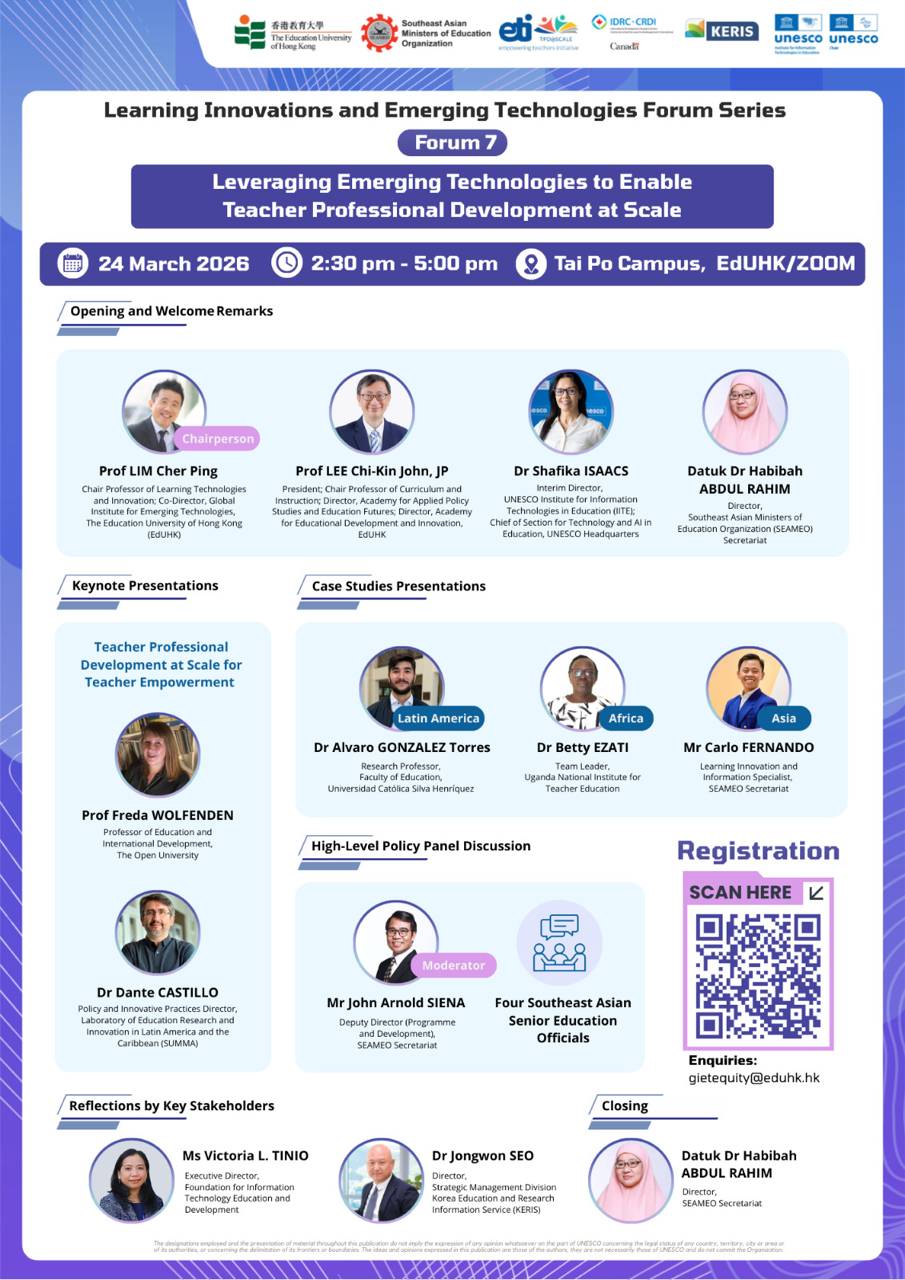
On 24 March, global education stakeholders will convene at the Education University of Hong Kong (EdUHK) and online for a major event on teacher professional development at scale (TPD@Scale), exploring how emerging technologies can better support teachers’ learning and practice.

The event is a collaborative effort between the Global Institute for Emerging Technologies Equity Team at The Education University of Hong Kong, UNESCO Institute for Information Technologies in Education (UNESCO IITE), SEAMEO Secretariat, Korea Education and Research Information Service (KERIS) and Empowering Teachers Initiative: TPD@Scale (ETI), with support from the International Development Research Centre and UNESCO Chairs Programme.

This forum will bring together international education leaders, policymakers, and experts to investigate how emerging technologies can transform teacher professional development at scale across the globe.

The forum will feature distinguished guests from UNESCO and the SEAMEO Secretariat, TPD@Scale experts at The Open University and SUMMA, and insightful case studies from Latin America, Africa, and Asia.

The event will culminate in a High-Level Policy Panel Discussion and reflections with key stakeholders from the Foundation for Information Technology Education and Development and KERIS.

SEAMEO


Event
  • 17.03.2026

Forum on Leveraging Emerging Technologies to Enable Teacher Professional Development at Scale (TPD@Scale)

On 24 March, global education stakeholders will convene at the Education University of Hong Kong (EdUHK) and online for a major event on teacher professional development at scale (TPD@Scale), exploring how emerging technologies can better support teachers’ learning and practice.

The event is a collaborative effort between the Global Institute for Emerging Technologies Equity Team at The Education University of Hong Kong, UNESCO Institute for Information Technologies in Education (UNESCO IITE), SEAMEO Secretariat, Korea Education and Research Information Service (KERIS) and Empowering Teachers Initiative: TPD@Scale (ETI), with support from the International Development Research Centre and UNESCO Chairs Programme.

This forum will bring together international education leaders, policymakers, and experts to investigate how emerging technologies can transform teacher professional development at scale across the globe.

The forum will feature distinguished guests from UNESCO and the SEAMEO Secretariat, TPD@Scale experts at The Open University and SUMMA, and insightful case studies from Latin America, Africa, and Asia.

The event will culminate in a High-Level Policy Panel Discussion and reflections with key stakeholders from the Foundation for Information Technology Education and Development and KERIS.

SEAMEO


Event
  • 17.03.2026

Forum on Leveraging Emerging Technologies to Enable Teacher Professional Development at Scale (TPD@Scale)

On 24 March, global education stakeholders will convene at the Education University of Hong Kong (EdUHK) and online for a major event on teacher professional development at scale (TPD@Scale), exploring how emerging technologies can better support teachers’ learning and practice.

The event is a collaborative effort between the Global Institute for Emerging Technologies Equity Team at The Education University of Hong Kong, UNESCO Institute for Information Technologies in Education (UNESCO IITE), SEAMEO Secretariat, Korea Education and Research Information Service (KERIS) and Empowering Teachers Initiative: TPD@Scale (ETI), with support from the International Development Research Centre and UNESCO Chairs Programme.

This forum will bring together international education leaders, policymakers, and experts to investigate how emerging technologies can transform teacher professional development at scale across the globe.

The forum will feature distinguished guests from UNESCO and the SEAMEO Secretariat, TPD@Scale experts at The Open University and SUMMA, and insightful case studies from Latin America, Africa, and Asia.

The event will culminate in a High-Level Policy Panel Discussion and reflections with key stakeholders from the Foundation for Information Technology Education and Development and KERIS.

SEAMEO