Event
  • 23.04.2026

4th Africa Teachers Webinar Series: Preparing teachers for AI-enabled classrooms

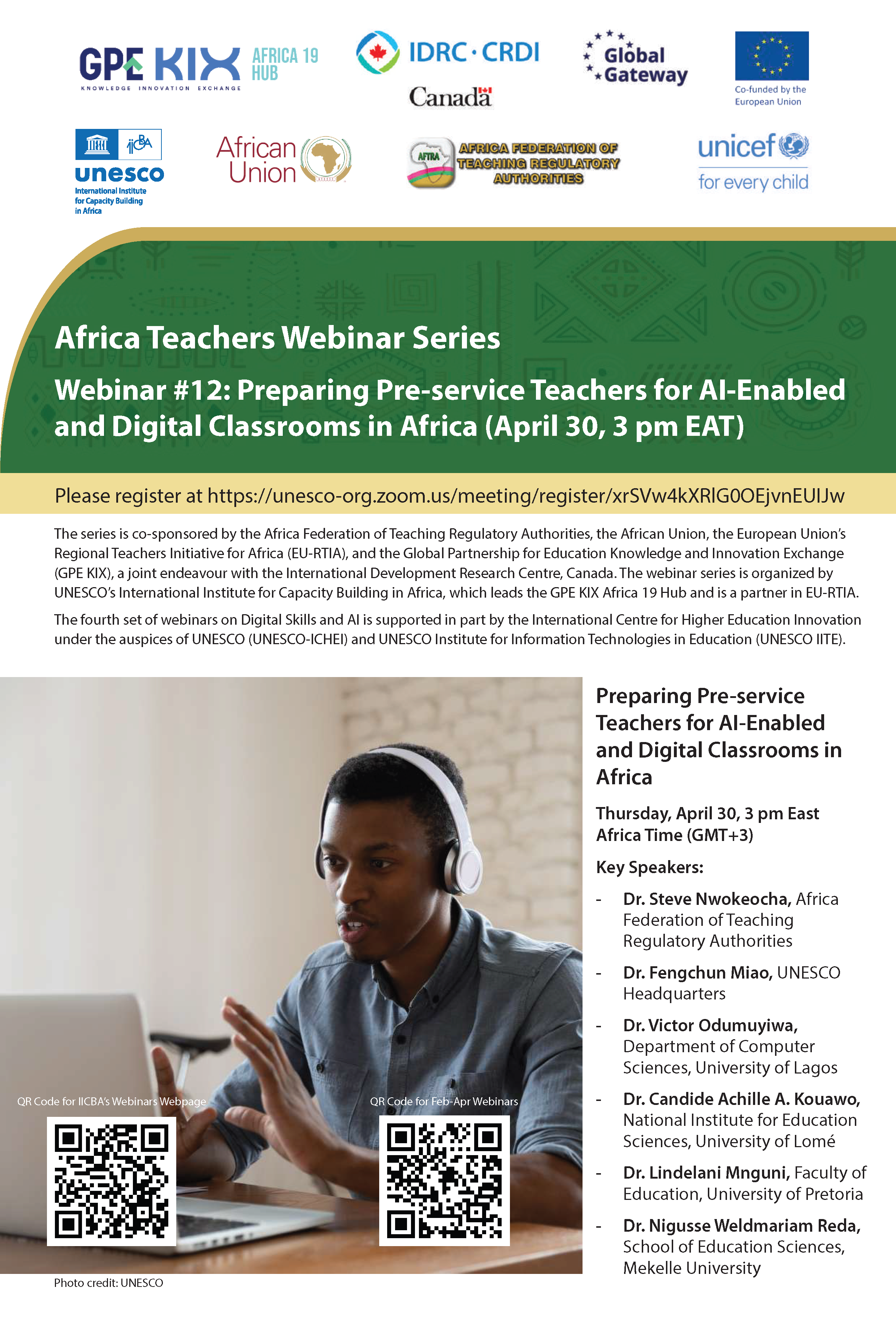
The Africa Teachers Webinar Series continues with its 12th webinar, part of the fourth set of webinars focused on digital skills and AI, reflecting an ongoing exchange on how to strengthen teaching across the continent.

Organized by UNESCO’s International Institute for Capacity Building in Africa (IICBA) with regional and global partners, the series highlights how teachers are adapting to digital transformation and the growing role of AI in education.

Webinar #12: Preparing Pre-service Teachers for AI-Enabled and Digital Classrooms in Africa will take place on:

  • 30 April, 3:00 PM EAT (GMT+3)

The session will explore how teacher education programmes can better equip future teachers with digital and AI-related competencies—supporting them to adapt pedagogy, use technology effectively, and respond to rapidly evolving classroom environments.

👉 Register: https://unesco-org.zoom.us/meeting/register/xrSVw4kXRlG0OEjvnEUIJw


Event
  • 23.04.2026

4th Africa Teachers Webinar Series: Preparing teachers for AI-enabled classrooms

The Africa Teachers Webinar Series continues with its 12th webinar, part of the fourth set of webinars focused on digital skills and AI, reflecting an ongoing exchange on how to strengthen teaching across the continent.

Organized by UNESCO’s International Institute for Capacity Building in Africa (IICBA) with regional and global partners, the series highlights how teachers are adapting to digital transformation and the growing role of AI in education.

Webinar #12: Preparing Pre-service Teachers for AI-Enabled and Digital Classrooms in Africa will take place on:

  • 30 April, 3:00 PM EAT (GMT+3)

The session will explore how teacher education programmes can better equip future teachers with digital and AI-related competencies—supporting them to adapt pedagogy, use technology effectively, and respond to rapidly evolving classroom environments.

👉 Register: https://unesco-org.zoom.us/meeting/register/xrSVw4kXRlG0OEjvnEUIJw


Blog
  • 23.04.2026

Low-tech, high impact: training teachers where they are

This blog has been co-authored by Prof. Sarah Younie, CEO, MESHGuides, and April Williamson, Director of Global Projects, Digital Promise, co-leads of the Teacher Task Force Thematic Group on Digital Education and Artificial Intelligence.


Teachers are at the heart of every education system, but in many parts of the world, they lack access to quality training and professional development. According to UNESCO and the Teacher Task Force, an estimated 44 million new teachers will be needed by 2030 to achieve the SDG 4 targets. Addressing this global teacher shortage requires a holistic approach, including training and accreditation systems that build professionalism and effectively support and develop teachers throughout their careers. Yet in many contexts — particularly those affected by crisis, limited infrastructure, and scarce resources — conventional training models fail to reach those who need them most.

The COVID-19 pandemic further highlighted the urgent need to equip large numbers of teachers with both foundational and 21st-century skills that are critical for lifelong learning and resilient societies. Teachers must be qualified, supported, and motivated — not only to provide quality teaching today, but also to prepare students for inclusive and increasingly digital societies. This is especially urgent in low- and middle-income countries, where scalable, low-cost, and rapidly deployable solutions are needed to meet the need for large-scale, high-quality, and effective training.

In this context, low-tech and mobile approaches — such as messenger-based training — are proving to be both relevant and cost-effective. Designed to function on basic phones with minimal bandwidth, these tools offer flexible, scalable, and accessible learning opportunities that meet teachers where they are. By leveraging tools that are already used by teachers, low-tech solutions can minimize, and even reduce, workload.

A number of members of the International Task Force on Teachers for Education 2030 (Teacher Task Force, or TTF) have been at the forefront of implementing such approaches. The TTF Thematic Group on Digital Education and AI, co-led by MeshGuides and Digital Promise, hosted a webinar, “Low-Tech, High Impact: Training Teachers Where They Are”, to highlight perspectives and lessons learned from two of these scalable, mobile-based teacher training solutions: the Future Teacher Kit and ProFuturo.


Mobile-based Teacher Training: Future Teacher Kit 

The Future Teacher Kit (FTK) is a mobile-based training approach tailored to reach teachers in a range of settings, including remote and crisis-affected areas. On behalf of the German Federal Ministry for Economic Cooperation and Development (BMZ), GIZ (Deutsche Gesellschaft für Internationale Zusammenarbeit) developed the Future Teacher Kit in collaboration with UNESCO and more than 1,500 teachers. The webinar highlighted perspectives on FTK implementation and impact from the Ministry of Education of Ecuador and the Jamaica Teaching Council, as well as GIZ, UNICEF and UNESCO.
 

“We know today that education systems owe teachers – not the other way around.” - Eilean von Lautz-Cauzanet, GIZ


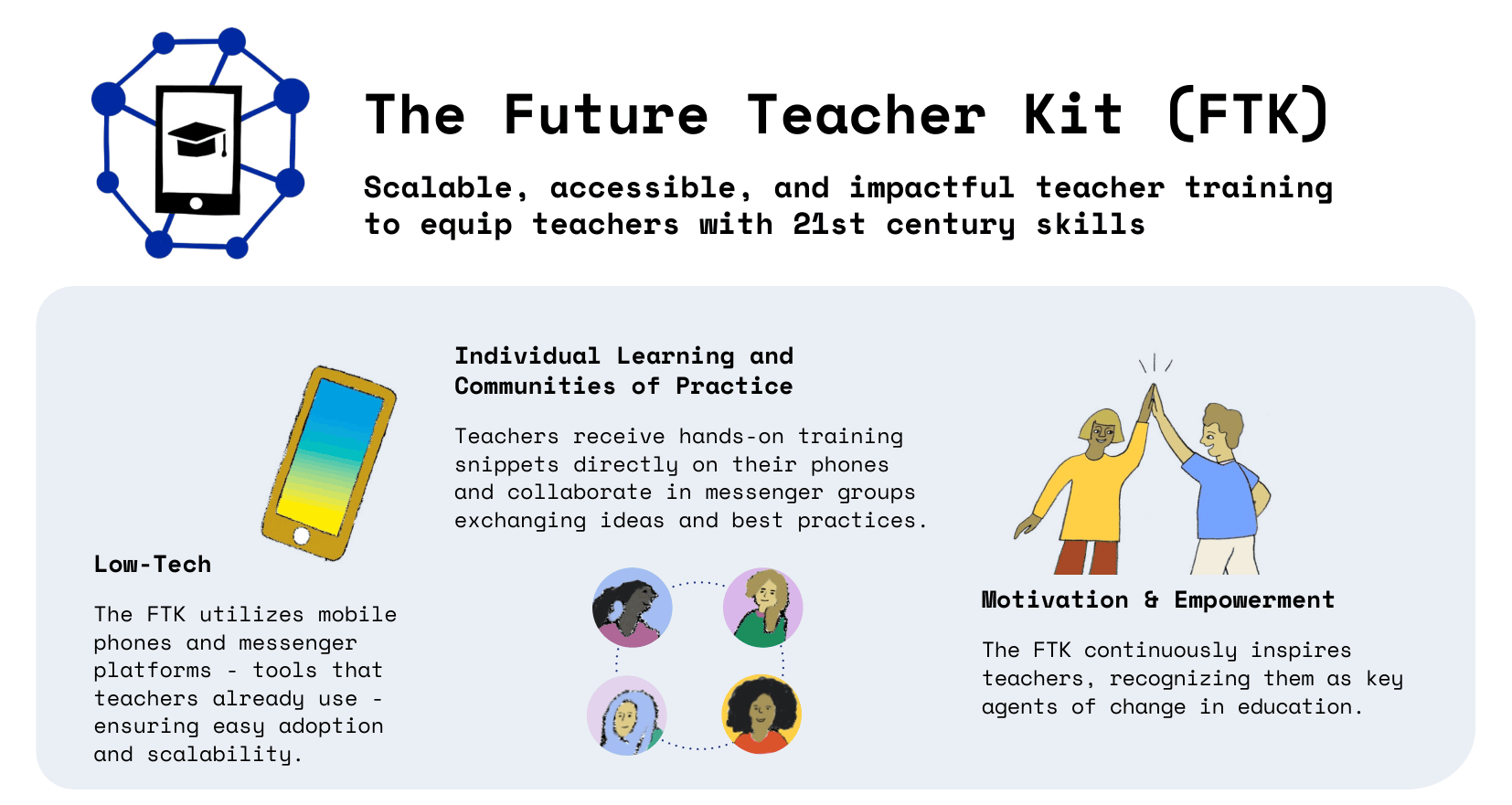
The FTK is an adaptive, scalable professional development solution designed to prepare educators for a rapidly evolving educational landscape by improving access, fostering communities of practice, and supporting education system resilience. It uses low-tech tools with high impact, such as messenger services, to reach teachers in low-connectivity areas. Through ambassador-led, participatory communities of practice, it promotes collaboration, intrinsic motivation, and self-paced learning, while strengthening teacher networks and institutional capacity. 
 

FTK
 Key characteristics of the Future Teacher Kit’s approach to ensuring scalable, accessible, and impactful teacher training.


UNICEF joined the FTK partnership in 2024, contributing its strong expertise in digital teacher development. UNICEF has developed the Superstar Teacher Toolbox, a tool to support educators to use mobile messaging for learning, including two practical guides on digital skills and mobile pedagogy. Its content has been integrated into the FTK, leveraging the UNICEF RapidPro platform for text-based delivery. This partnership is enhancing the FTK’s scalability and pedagogical quality. 
 

“The Future Teacher Kit reignited my love for teaching. It reminded me that I could grow, even in a digital world. It wasn't just training—it was transformation.” - FTK Cohort Participant 


Competency-based Digital Skills Training: ProFuturo 

As a leader in digital teacher training, ProFuturo shared complementary experiences and practical lessons from their work in low-resource contexts. ProFuturo is an education innovation programme based on technology, founded in 2016 by Telefonica Foundation and “La Caixa” Foundation. 

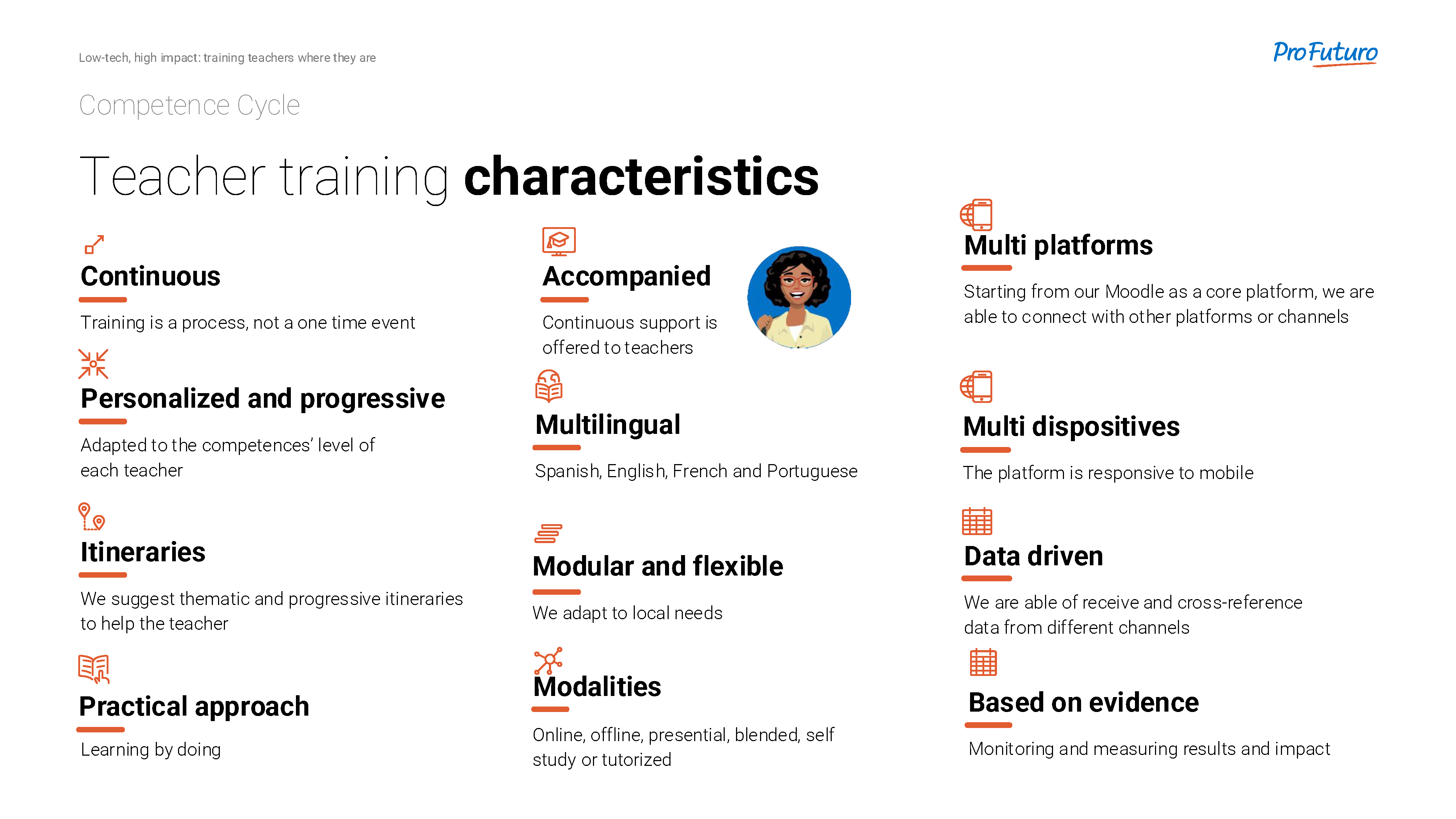
Learning and teaching are two essential processes in today’s society. To address them holistically, ProFuturo has developed the Global Framework for Educational Competence in the Digital Era. This framework supports lifelong learning, especially for teachers, and invites the educational community to reflect on the meaning of learning and teaching in the digital age, and on the teacher’s pivotal role in both. Their teacher training approach is based on an ongoing competence cycle that involves:

  1. Measurement to understand teachers’ competences, through tools like the Self-Assessment of Digital Skills for Teachers.
  2. Training that is continuous, flexible, progressive, and practical, to reduce skills gaps and empower teachers. 
  3. Practice, with access to a broad catalogue of online and offline educational resources for classroom use. 
     
ProFuturo
Key characteristics of ProFuturo’s approach to teacher training.


Through implementing their solutions with 1.8 million teachers in 30 countries, ProFuturo has identified a number of key lessons. Educational change is a cultural and systemic process centered on teachers, making their training essential for improving quality. This focus on teachers ensures high-quality training delivery, while flexibility and preparedness allow effective responses to diverse situations and challenges. 

Recognizing limits and managing expectations, alongside sustaining continuous innovation and strong collaboration, allow organizations like ProFuturo to address the complexity of training teachers across extremely diverse contexts. 
 

“Strategic partnerships enable the sharing of resources and expertise, ensuring that the program is well-supported and aligned with global educational initiatives” - Mila Tonarelli, ProFuturo


Key Takeaways and Next Steps

After the webinar, participants were surveyed to gather perspectives on teacher training strategies and needs in their own contexts. The following common themes emerged: 

  1. Teachers of the future will need to be digitally fluent, adaptable lifelong learners who foster student well-being, communicate effectively, and navigate evolving pedagogical and technological landscapes.
  2. Key teacher training challenges include limited funding and infrastructure; inequitable access to training opportunities, particularly in rural areas; and an overfocus on pre-service training with a lack of ongoing, relevant, and inclusive professional development.
  3. Successful teacher training strategies encompass peer and community-based learning; flexible digital and hybrid formats; hands-on coaching; and practical, learner-centered approaches that promote collaboration and continuous growth. Necessary conditions for effective training partnerships include a shared vision and trust, mutual commitment with aligned goals, and empowered and actively engaged local teams.

Based on the discussion, it’s clear that this is a common priority. There is a need for low-tech and mobile teacher training and ongoing professional development across all education systems. This initial webinar and blog are the start of a series of professional conversations in which the Teacher Task Force members dive deeper into the challenges, solutions, and best practices. 
 

Additional Resources

Future Teacher Kit

ProFuturo


Hero photo credit: BMZ, GIZ, UNESCO, UNICEF.

Event
  • 17.03.2026

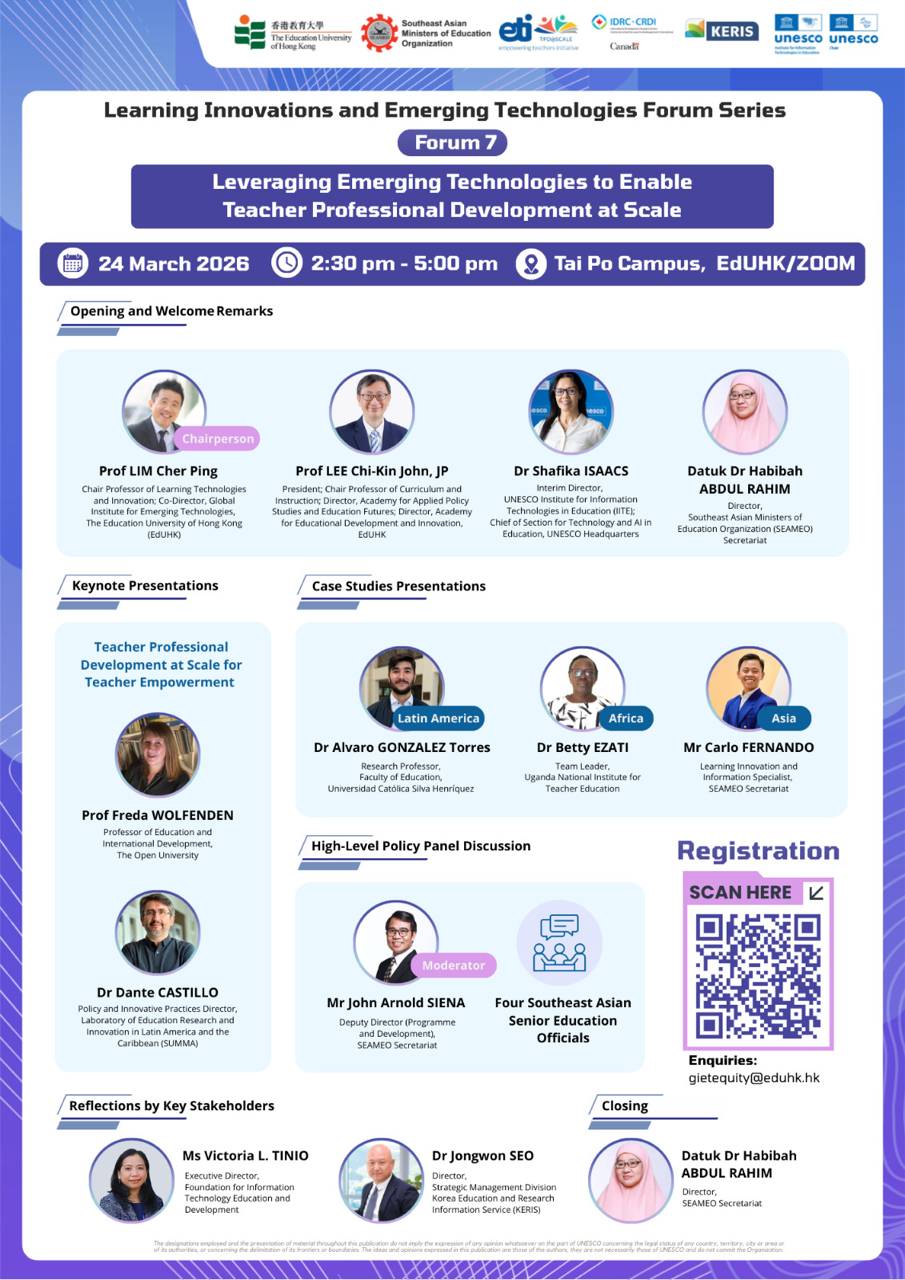
Forum on Leveraging Emerging Technologies to Enable Teacher Professional Development at Scale (TPD@Scale)

On 24 March, global education stakeholders will convene at the Education University of Hong Kong (EdUHK) and online for a major event on teacher professional development at scale (TPD@Scale), exploring how emerging technologies can better support teachers’ learning and practice.

The event is a collaborative effort between the Global Institute for Emerging Technologies Equity Team at The Education University of Hong Kong, UNESCO Institute for Information Technologies in Education (UNESCO IITE), SEAMEO Secretariat, Korea Education and Research Information Service (KERIS) and Empowering Teachers Initiative: TPD@Scale (ETI), with support from the International Development Research Centre and UNESCO Chairs Programme.

This forum will bring together international education leaders, policymakers, and experts to investigate how emerging technologies can transform teacher professional development at scale across the globe.

The forum will feature distinguished guests from UNESCO and the SEAMEO Secretariat, TPD@Scale experts at The Open University and SUMMA, and insightful case studies from Latin America, Africa, and Asia.

The event will culminate in a High-Level Policy Panel Discussion and reflections with key stakeholders from the Foundation for Information Technology Education and Development and KERIS.

SEAMEO


Event
  • 17.03.2026

Forum on Leveraging Emerging Technologies to Enable Teacher Professional Development at Scale (TPD@Scale)

On 24 March, global education stakeholders will convene at the Education University of Hong Kong (EdUHK) and online for a major event on teacher professional development at scale (TPD@Scale), exploring how emerging technologies can better support teachers’ learning and practice.

The event is a collaborative effort between the Global Institute for Emerging Technologies Equity Team at The Education University of Hong Kong, UNESCO Institute for Information Technologies in Education (UNESCO IITE), SEAMEO Secretariat, Korea Education and Research Information Service (KERIS) and Empowering Teachers Initiative: TPD@Scale (ETI), with support from the International Development Research Centre and UNESCO Chairs Programme.

This forum will bring together international education leaders, policymakers, and experts to investigate how emerging technologies can transform teacher professional development at scale across the globe.

The forum will feature distinguished guests from UNESCO and the SEAMEO Secretariat, TPD@Scale experts at The Open University and SUMMA, and insightful case studies from Latin America, Africa, and Asia.

The event will culminate in a High-Level Policy Panel Discussion and reflections with key stakeholders from the Foundation for Information Technology Education and Development and KERIS.

SEAMEO


Event
  • 17.03.2026

Forum on Leveraging Emerging Technologies to Enable Teacher Professional Development at Scale (TPD@Scale)

On 24 March, global education stakeholders will convene at the Education University of Hong Kong (EdUHK) and online for a major event on teacher professional development at scale (TPD@Scale), exploring how emerging technologies can better support teachers’ learning and practice.

The event is a collaborative effort between the Global Institute for Emerging Technologies Equity Team at The Education University of Hong Kong, UNESCO Institute for Information Technologies in Education (UNESCO IITE), SEAMEO Secretariat, Korea Education and Research Information Service (KERIS) and Empowering Teachers Initiative: TPD@Scale (ETI), with support from the International Development Research Centre and UNESCO Chairs Programme.

This forum will bring together international education leaders, policymakers, and experts to investigate how emerging technologies can transform teacher professional development at scale across the globe.

The forum will feature distinguished guests from UNESCO and the SEAMEO Secretariat, TPD@Scale experts at The Open University and SUMMA, and insightful case studies from Latin America, Africa, and Asia.

The event will culminate in a High-Level Policy Panel Discussion and reflections with key stakeholders from the Foundation for Information Technology Education and Development and KERIS.

SEAMEO


Event
  • 08.09.2025

Powering Education Systems Through School Leadership: The missing link between Policy and Practice

School leaders are frontline architects of education reform. Yet their voices are too often absent from global education dialogues. Join us for a 60-minute interactive session—hosted by the Teacher Task Force Thematic Group, the School Leadership Network, and led by the Varkey Foundation and Global School Leaders—as we highlight the lived experiences of school leaders from the Global South

Through focused discussion on the role of school leadership in advancing foundational literacy and numeracy (FLN) strategies, building gender-equitable schools, and technology in education, panelists will share what has worked—and what hasn’t—when translating policy into practice. This session, which will bring together School Leaders from India and Argentina, key system thinkers and policy-shapers, to highlight the role of school leadership in equipping students to shape a better future.

Key Speakers:

  • Fernando Giménez Zapiola, Head of School, Argentina
  • K. Naga Seetha, School Principal, India
  • Emma Nothmann, Partner, Bridgespan Group, San Frasisco
  • Camila Pereira, CEO, Global School Leaders (moderator)

Should you have any questions, please reach out to Adhishree (adhishree@globalschoolleaders.org).

Register for the event here.

Event
  • 28.05.2025

Low-tech, high impact: Training teachers where they are – Scalable Mobile-based Teacher Training Solutions: Lessons Learned and Perspectives

A webinar titled Low-tech, high impact: Training teachers where they are - Scalable Mobile-based Teacher Training Solutions: Lessons Learned and Perspectives will take place on 4 June at 15:00 CET (GMT+2) via Zoom. 

Organised by the International Teacher Task Force, its Thematic Group on Digital & AI, co-led by MESHGuides and Digital Promise, and the German Federal Ministry for Economic Cooperation and Development (BMZ), through GIZ, the webinar aims to showcase innovative low-tech training approaches that enable in-service teacher professional development in low-resource and crisis-affected contexts.

Click here to register for the webinar.

Background
With an estimated global need for 44 million new teachers by 2030 to meet SDG 4 targets, effective and scalable training solutions are critical. Conventional models often fail to reach teachers in remote or crisis-affected areas. The COVID-19 pandemic further underscored the urgency of equipping teachers with foundational and 21st-century skills needed for resilient and inclusive education systems. Low-tech mobile solutions, such as SMS and WhatsApp-based training, offer flexible, accessible, and scalable opportunities that meet teachers where they are.

Speakers and programme highlights

  • Carlos Vargas, Head of the Teacher Task Force Secretariat, will provide the welcome and background introduction.

  • A representative from GIZ will introduce the presented solutions.

  • ProFuturo, a leader in digital teacher training, will share insights and lessons learned from implementing teacher training programs in low-resource contexts.

  • The Future Teacher Kit (a joint initiative by GIZ, UNESCO, and UNICEF) will be presented, highlighting mobile-supported teacher training tailored for remote and crisis-affected settings. This segment will include contributions from the Jamaican Teaching Council, Ministry of Education Ecuador, UNESCO Ecuador, UNESCO Jamaica, and UNICEF’s Helsinki Global Innovation Learning Hub.

The webinar will also include Q&A sessions and a moderated discussion facilitated by the co-leads of the TTF Thematic Group on Digital Education and AI. Discussion topics will address key future skills for teachers, challenges and successful strategies in teacher training, as well as barriers and enablers for scaling mobile-based approaches and partnerships.

Objectives

  • To showcase effective low-tech teacher training models that support professional development in challenging environments.
  • To share implementation experiences and lessons learned from diverse contexts.
  • To facilitate dialogue among stakeholders, including education ministries, teacher training institutions, development partners, and civil society.
  • To explore practical challenges and opportunities in scaling mobile-based training and policy implications.

Expected outcomes
Participants are expected to gain a deeper understanding of mobile-based teacher training approaches and to be inspired to adapt and scale such models in their own national contexts.

Additional information
The webinar will be conducted in English only; interpretation will not be available.

Registration
Please register here.