Blog
  • 23.04.2026

Low-tech, high impact: training teachers where they are

This blog has been co-authored by Prof. Sarah Younie, CEO, MESHGuides, and April Williamson, Director of Global Projects, Digital Promise, co-leads of the Teacher Task Force Thematic Group on Digital Education and Artificial Intelligence.


Teachers are at the heart of every education system, but in many parts of the world, they lack access to quality training and professional development. According to UNESCO and the Teacher Task Force, an estimated 44 million new teachers will be needed by 2030 to achieve the SDG 4 targets. Addressing this global teacher shortage requires a holistic approach, including training and accreditation systems that build professionalism and effectively support and develop teachers throughout their careers. Yet in many contexts — particularly those affected by crisis, limited infrastructure, and scarce resources — conventional training models fail to reach those who need them most.

The COVID-19 pandemic further highlighted the urgent need to equip large numbers of teachers with both foundational and 21st-century skills that are critical for lifelong learning and resilient societies. Teachers must be qualified, supported, and motivated — not only to provide quality teaching today, but also to prepare students for inclusive and increasingly digital societies. This is especially urgent in low- and middle-income countries, where scalable, low-cost, and rapidly deployable solutions are needed to meet the need for large-scale, high-quality, and effective training.

In this context, low-tech and mobile approaches — such as messenger-based training — are proving to be both relevant and cost-effective. Designed to function on basic phones with minimal bandwidth, these tools offer flexible, scalable, and accessible learning opportunities that meet teachers where they are. By leveraging tools that are already used by teachers, low-tech solutions can minimize, and even reduce, workload.

A number of members of the International Task Force on Teachers for Education 2030 (Teacher Task Force, or TTF) have been at the forefront of implementing such approaches. The TTF Thematic Group on Digital Education and AI, co-led by MeshGuides and Digital Promise, hosted a webinar, “Low-Tech, High Impact: Training Teachers Where They Are”, to highlight perspectives and lessons learned from two of these scalable, mobile-based teacher training solutions: the Future Teacher Kit and ProFuturo.


Mobile-based Teacher Training: Future Teacher Kit 

The Future Teacher Kit (FTK) is a mobile-based training approach tailored to reach teachers in a range of settings, including remote and crisis-affected areas. On behalf of the German Federal Ministry for Economic Cooperation and Development (BMZ), GIZ (Deutsche Gesellschaft für Internationale Zusammenarbeit) developed the Future Teacher Kit in collaboration with UNESCO and more than 1,500 teachers. The webinar highlighted perspectives on FTK implementation and impact from the Ministry of Education of Ecuador and the Jamaica Teaching Council, as well as GIZ, UNICEF and UNESCO.
 

“We know today that education systems owe teachers – not the other way around.” - Eilean von Lautz-Cauzanet, GIZ


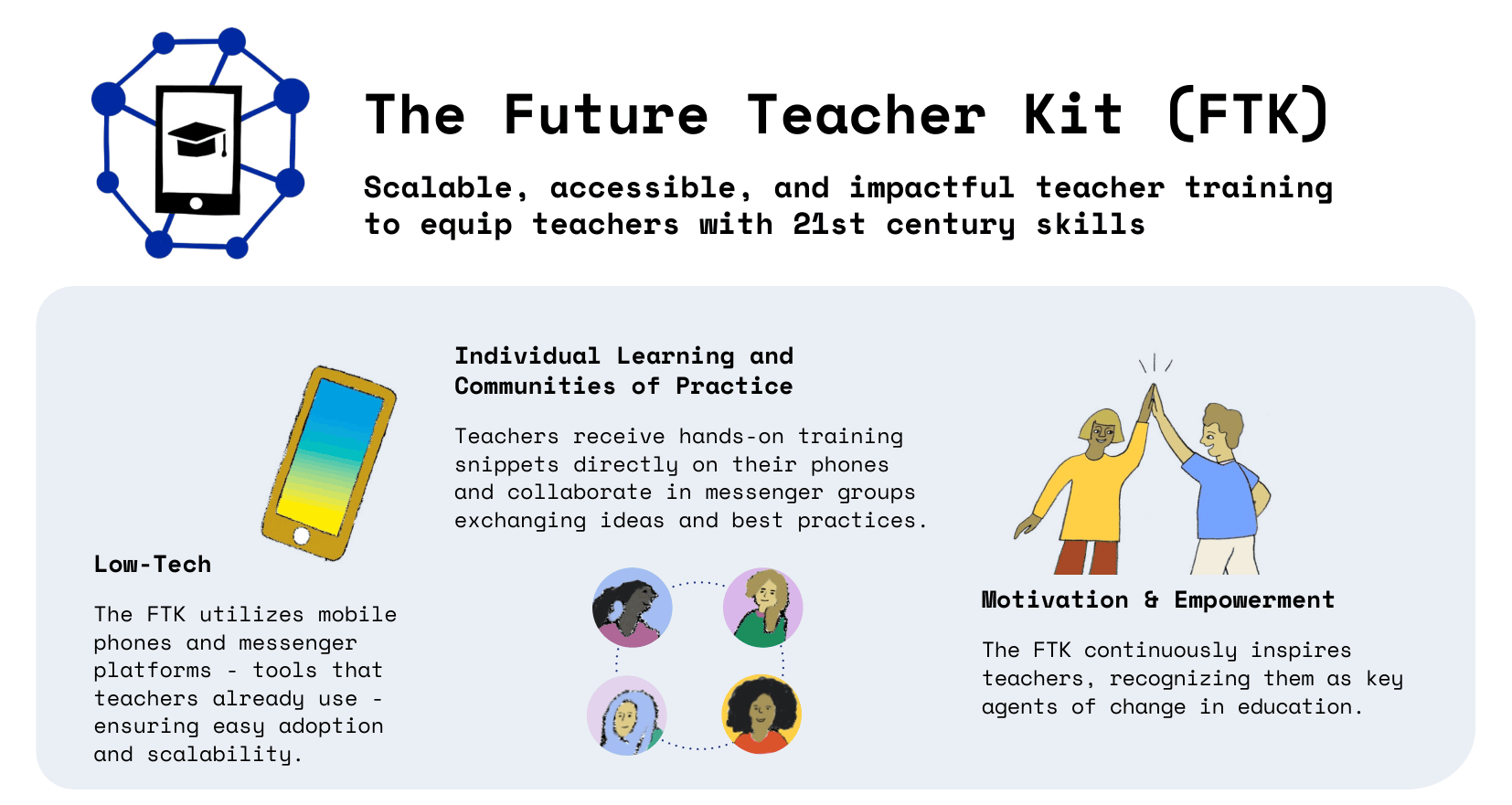
The FTK is an adaptive, scalable professional development solution designed to prepare educators for a rapidly evolving educational landscape by improving access, fostering communities of practice, and supporting education system resilience. It uses low-tech tools with high impact, such as messenger services, to reach teachers in low-connectivity areas. Through ambassador-led, participatory communities of practice, it promotes collaboration, intrinsic motivation, and self-paced learning, while strengthening teacher networks and institutional capacity. 
 

FTK
 Key characteristics of the Future Teacher Kit’s approach to ensuring scalable, accessible, and impactful teacher training.


UNICEF joined the FTK partnership in 2024, contributing its strong expertise in digital teacher development. UNICEF has developed the Superstar Teacher Toolbox, a tool to support educators to use mobile messaging for learning, including two practical guides on digital skills and mobile pedagogy. Its content has been integrated into the FTK, leveraging the UNICEF RapidPro platform for text-based delivery. This partnership is enhancing the FTK’s scalability and pedagogical quality. 
 

“The Future Teacher Kit reignited my love for teaching. It reminded me that I could grow, even in a digital world. It wasn't just training—it was transformation.” - FTK Cohort Participant 


Competency-based Digital Skills Training: ProFuturo 

As a leader in digital teacher training, ProFuturo shared complementary experiences and practical lessons from their work in low-resource contexts. ProFuturo is an education innovation programme based on technology, founded in 2016 by Telefonica Foundation and “La Caixa” Foundation. 

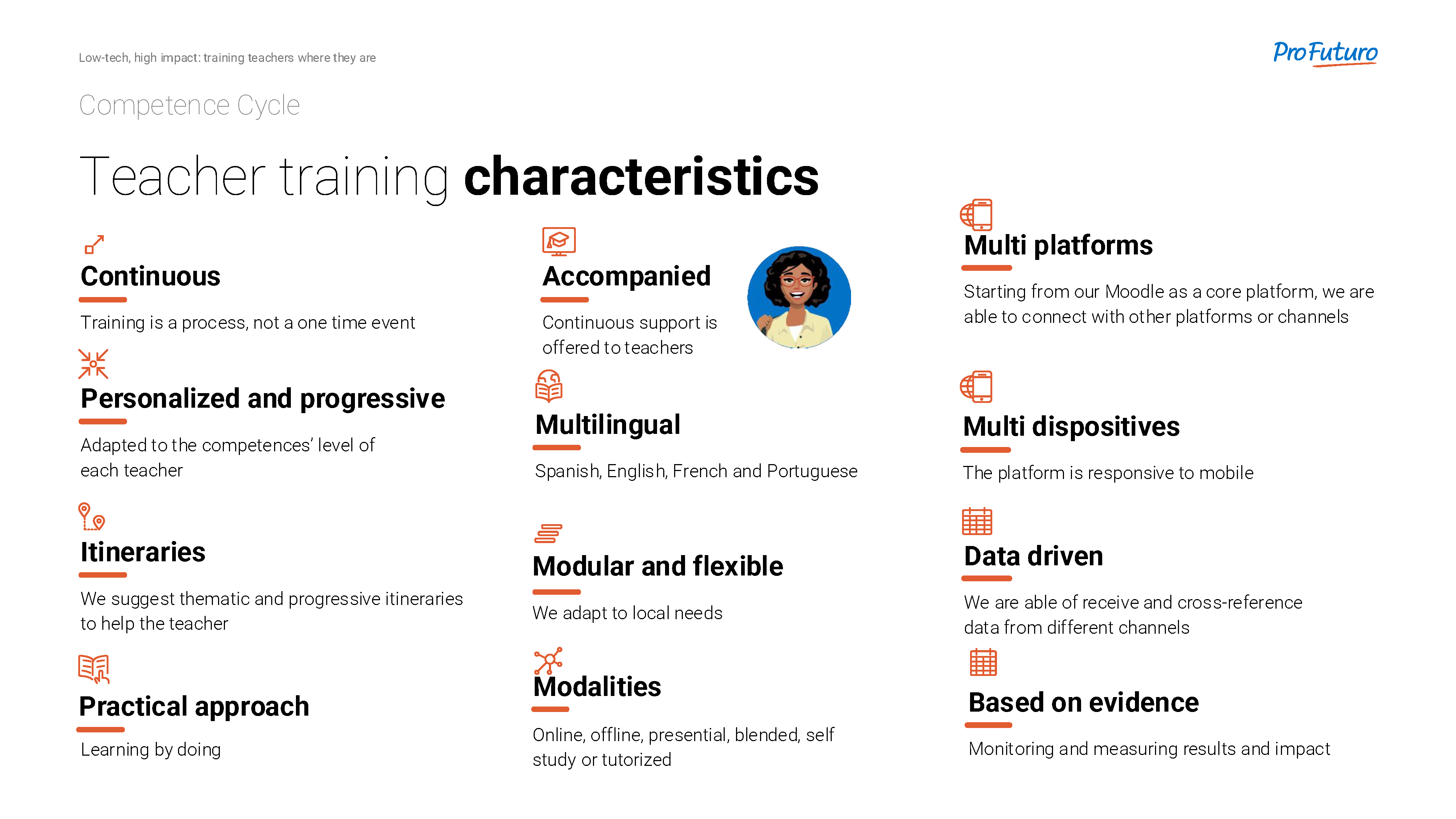
Learning and teaching are two essential processes in today’s society. To address them holistically, ProFuturo has developed the Global Framework for Educational Competence in the Digital Era. This framework supports lifelong learning, especially for teachers, and invites the educational community to reflect on the meaning of learning and teaching in the digital age, and on the teacher’s pivotal role in both. Their teacher training approach is based on an ongoing competence cycle that involves:

  1. Measurement to understand teachers’ competences, through tools like the Self-Assessment of Digital Skills for Teachers.
  2. Training that is continuous, flexible, progressive, and practical, to reduce skills gaps and empower teachers. 
  3. Practice, with access to a broad catalogue of online and offline educational resources for classroom use. 
     
ProFuturo
Key characteristics of ProFuturo’s approach to teacher training.


Through implementing their solutions with 1.8 million teachers in 30 countries, ProFuturo has identified a number of key lessons. Educational change is a cultural and systemic process centered on teachers, making their training essential for improving quality. This focus on teachers ensures high-quality training delivery, while flexibility and preparedness allow effective responses to diverse situations and challenges. 

Recognizing limits and managing expectations, alongside sustaining continuous innovation and strong collaboration, allow organizations like ProFuturo to address the complexity of training teachers across extremely diverse contexts. 
 

“Strategic partnerships enable the sharing of resources and expertise, ensuring that the program is well-supported and aligned with global educational initiatives” - Mila Tonarelli, ProFuturo


Key Takeaways and Next Steps

After the webinar, participants were surveyed to gather perspectives on teacher training strategies and needs in their own contexts. The following common themes emerged: 

  1. Teachers of the future will need to be digitally fluent, adaptable lifelong learners who foster student well-being, communicate effectively, and navigate evolving pedagogical and technological landscapes.
  2. Key teacher training challenges include limited funding and infrastructure; inequitable access to training opportunities, particularly in rural areas; and an overfocus on pre-service training with a lack of ongoing, relevant, and inclusive professional development.
  3. Successful teacher training strategies encompass peer and community-based learning; flexible digital and hybrid formats; hands-on coaching; and practical, learner-centered approaches that promote collaboration and continuous growth. Necessary conditions for effective training partnerships include a shared vision and trust, mutual commitment with aligned goals, and empowered and actively engaged local teams.

Based on the discussion, it’s clear that this is a common priority. There is a need for low-tech and mobile teacher training and ongoing professional development across all education systems. This initial webinar and blog are the start of a series of professional conversations in which the Teacher Task Force members dive deeper into the challenges, solutions, and best practices. 
 

Additional Resources

Future Teacher Kit

ProFuturo


Hero photo credit: BMZ, GIZ, UNESCO, UNICEF.

Event
  • 20.02.2026

2026 Global Education Coalition Sixth Annual Meeting - Teacher sessions

The UNESCO Global Education Coalition will convene its Sixth Annual Meeting on 24 March 2026 at UNESCO Headquarters in Paris, preceded by a country engagement day on 23 March.

Held under the theme “Turning vision into value: Transforming education together,” the meeting will bring together UNESCO Member States, Coalition members, including of our network, and education stakeholders to examine the socio-economic impact of investing in digital transformation and artificial intelligence (AI). Discussions will focus on how system-wide, country-led approaches can translate digital and AI investments into meaningful social and economic outcomes for learners, teachers and societies.
 

Dedicated session: AI and Teacher Education

24 March, 14:40-15:00, Room VI

A dedicated teacher-focused session, titled “Exploring AI in Teacher Education and Training: Pedagogies, Platforms, Programmes, & Policies,” will explore how AI is reshaping teacher education systems.

Bringing together diverse perspectives from teacher educators and practitioners, the session will examine:

  • How AI is influencing classroom pedagogy and redefining teachers’ roles, including implications for quality, equity and inclusion;
  • The platforms and tools being used in teacher education, and the responsibilities of technology providers;
  • How pre-service and in-service programmes are integrating AI, and what forms of support enable teachers to engage ethically and effectively;
  • The policy and institutional frameworks needed to guide sustainable and responsible AI integration in teacher education.

The discussion aims to generate practical insights and actionable considerations to support teacher professional development in an AI-enabled education landscape.

Speakers:

  • Ms Agnieszka Szplit, President, Association for Teacher Education in Europe
  • Ms. April Williamson, Director, Global Projects, Digital Promise
  • Ms. Ekaterina Efimenko, Policy Coordinator for Democracy, Equality and Environment, ETUCE/ Education International

Plenary

24 March, 12:00-12:15, Room I

In addition, a plenary fireside conversation is anticipated to highlight the broader impact of teacher professional development on schools and societies. Through high-level dialogue and focused technical exchange, the 2026 Annual Meeting will reinforce collaboration across the Coalition and support collective efforts to prepare education systems – and the teaching profession – for an increasingly digital and AI-driven future.

Learn more about the event and register here.

Blog
  • 21.01.2026

Our 2025 wrapped: Reflecting on the TTF’s impact for teachers

2025 marked a year full of engaging opportunities, fruitful discussions, and productive advancements towards achieving SDG 4 target 4.c through the work of the Teacher Task Force (TTF), especially amid ever-changing geopolitical shifts. Activities in 2025 continued to be structured around knowledge production and dissemination, advocacy, and national and regional policy learning, marking the final year of our 2022-2025 Strategic Plan.

Month to month, the TTF raised awareness and expanded knowledge across key issues concerning teachers: from building AI competencies to promoting collaboration to advocating for greater financing of the teaching profession.

Moving with the same momentum into 2026 and beginning of a new Strategic Plan cycle, the TTF enters another year full of meaningful dialogue, reflection and stocktaking around innovative policies, and global action aimed at improving teachers’ working conditions, education and well-being. As the year comes to an end, it is important to reflect on the accomplishments from 2025 that will set the pace for the upcoming year.

Global efforts propelling the teaching agenda

The TTF participated in dozens of global events prioritizing sustainable teacher development initiatives, ultimately leading to one of the largest initiatives of the year, the World Summit on Teachers in Santiago de Chile. Building on the 2024 Global Report on Teachers (GRT) and the 14th Policy Dialogue Forum (PDF), the Summit culminated in the adoption of the Santiago Consensus, which was developed collaboratively under the auspices of UNESCO and the TTF, the SDG4-Education 2030 High-Level Steering Committee, youth networks, teachers and organizations. At its core, the Santiago Consensus underscores the indispensable role of teachers in education systems worldwide and recognizes the key role that the TTF plays and should play in fostering teacher policy development and implementation.

Chile

Youth engagement formed part of the TTF’s wider advocacy and partnership work in 2025. Collaboration with the SDG4 Youth & Student Network supported dialogue around the Santiago Consensus and broader global exchanges on addressing teacher shortages and transforming the profession into one that is respected and empowered.

World Teachers’ Day served as another successful opportunity to advocate for teachers. This year’s theme, “Recasting teaching as a collaborative profession,” illustrated the significance of collaboration among teachers, an invaluable facet that will characterize the profession moving forward. The 2025 World Teachers’ Day fact sheet sheds more light on ever-evolving trends in the teaching profession and examines how to cultivate collective thinking.

Informing policy creation through knowledge products and reports

The vast knowledge produced by the network continued to spearhead advocacy campaigns and played an influential role in informing political decisions aimed at improving teacher conditions, beginning with further dissemination of the 2024 Global Report on Teachers. The TTF successfully launched the Portuguese version of the report in Brasília and the Spanish version through three national launches in Madrid, Seville and Valencia, as well as a regional launch in Chile for Latin America, strengthening advocacy efforts at both regional and national level. In parallel, work advanced on the forthcoming 2026 edition through Editorial Board meetings.

New evidence also emerged this year, such as Costing and financing the teaching profession: A strategic investment in education, a paper offering strategic guidance for governments and education stakeholders on funding the profession. Promoting and protecting teacher agency in the age of artificial intelligence and its quick guide are that support understanding of major advances in artificial intelligence (AI) and how these can be adapted to teachers’ needs. Both papers set the course for the future of the education agenda, highlighting strategies to finance the teaching profession and analyzing the role of AI in classrooms.

New Evidence

Developed in line with World Teachers’ Day 2025, the World Teachers’ Day fact sheet, published by the TTF and UNESCO Institute for Statistics (UIS), highlights new trends and data related to the teaching profession and how these insights can support continuous professional development.

The TTF further contributed to knowledge generation through its participation in the APPRENDRE international seminar in Dakar in October 2025, where the Secretariat shared key highlights from a forthcoming paper on Teacher Management Information Systems (TMIS) in sub-Saharan Africa, underscoring the role of reliable teacher data in supporting effective planning and evidence-based policymaking.

Continuing to advocate for inclusive education

Inclusive education was a major theme in the work of the TTF this year, playing a part in multiple events, such as the Global Disability Summit and International Day of Persons with Disabilities. The advocacy campaign Teachers without limits: Voices we must hear, leaders we must follow, led by the TTF’s Thematic Group on Inclusion and Equity in Teacher Policies and Practices, exemplified member-led collaboration by amplifying the leadership and lived experiences of teachers with disabilities through blogs, interviews and social media.

Inclusive

In parallel, the TTF continued its engagement in youth-led advocacy around the Santiago Consensus, ensuring sustained attention to its core messages on inclusive and equitable education.

Supporting teacher policies at a national and regional level

The Teacher Policy Development Guide (TPDG) continued to support evidence-informed teacher policies, helping ensure that every learner is taught by qualified, trained and well-supported teachers. Regional webinars included a policy learning webinar in the Asia-Pacific region, co-organized with INRULED, focused on rural teacher policies and lessons from implementation, as well as a regional webinar for Arab States – facilitated by RCQE – on the costing and financing of teacher policies, with insights feeding into the development of new TPDG modules.

Looking ahead at 2026

With all the transformative work from 2025 paving the way, the year ahead will continue to foster inclusive, equitable, and quality opportunities for teachers through policy dialogues, reports, advocacy campaigns, and global events. Major milestones will include the release of the 2026-2029 Strategic Plan and the next edition of the Global Report on Teachers, as well as ongoing dissemination and contextualization of the Santiago Consensus.

The TTF offers a warm thank you to its members and partners for their collaboration and unwavering support towards realizing SDG 4. As we embark on a new year, it is critical to recognize the contributions of the network and commitment to bettering the teaching profession.

To learn more about the many accomplishments of the TTF and its members this past year, explore our blogs and subscribe to our newsletter.

2026 upcoming highlights: