Blog
  • 21.05.2026

Teaching through displacement: why refugee teachers are key to solving the global teacher shortage

This blog has been authored by UNESCO and the Secretariat of the Teacher Task Force.


In classrooms shaped by crisis and displacement, refugee teachers are already making learning possible. But without recognition and support, their contribution remains overlooked. A joint UNESCO and Teacher Task Force webinar explored how changing this could transform education systems. 

On 4 March 2026, UNESCO and the International Task Force on Teachers for Education 2030 (Teacher Task Force) brought together educators, policymakers and partners to address a pressing question: how can refugee teachers be better recognized and supported in response to global teacher shortages? 

For Alhamis Dicko, a refugee teacher from Mali living in Mauritania, the issue is deeply personal. 

“Teachers are human beings, they have families, they deserve stability and dignity,” he said. 

Speaking during the webinar Recognizing and Empowering Refugee Teachers: A Sustainable Response to Teacher Shortages in Crisis-Affected Contexts, he described what it means to teach in displacement, and what is lost when refugee teachers are not recognized and supported. 

Teaching against the odds 

In refugee-hosting communities, education is often one of the few sources of stability for children affected by crisis. But it depends on teachers, many of whom are refugees themselves. 

Across regions such as the Eastern Horn of Africa, refugee teachers make up a significant share of the workforce. Yet many work without formal contracts, professional recognition or adequate pay, often outside national systems. 

Dicko described colleagues leaving the profession because they could not afford to stay. Others remain, but with no clear pathway to recognition. 

“When teachers are secure, education is secure,” he said. 

This reality was echoed by Margaret Atto, a refugee teacher in Uganda, who described multilingual classrooms shaped by displacement. Refugee teachers, she explained, play a vital role in bridging communication gaps and supporting learning. 

“Our efforts should really not be taken for granted,” she said. “We are very resourceful.” 

A global challenge – and a missed opportunity 

The recent UNESCO–Teacher Task Force Global Report on Teachers estimates 44 million additional teachers are needed by 2030 to achieve SDG 4 – nearly 58% to replace those leaving the profession. 

At the same time, many qualified refugee teachers remain excluded by barriers to qualification recognition, certification and employment. 

“Recognizing refugee teachers is not separate from the global agenda — it is part of it,” said Carlos Vargas, Chief of UNESCO’s Section for Teacher Development and Head of the Teacher Task Force Secretariat. 

This reflects international commitments, including the Santiago Consensus adopted at the World Summit on Teachers last year, which calls for more inclusive, diverse and well-supported teaching workforces. 

From parallel systems to inclusion 

Speakers called for moving beyond temporary, parallel systems toward full inclusion of refugee teachers in national education systems – in line with SDG 4, particularly Target 4.c on increasing the supply of qualified teachers. 

Geofrey Tanui of Save the Children Kenya illustrated how this plays out in practice. In Kenya, refugee teachers make up a large share of the workforce in camp settings, yet still face barriers to training and certification. Efforts are underway to open more inclusive pathways into teacher training and align qualifications with national standards. 

Tools such as the UNESCO Qualifications Passport help countries assess qualifications when documentation is incomplete. Stella Chipeta of the Zambia Qualifications Authority shared how this approach is being used in Zambia, while noting that recognition must link to national policies and employment systems to lead to real inclusion. 

Listening to teachers and learning from evidence 

The webinar also highlighted research from Jigsaw Education. 

Katrina Barnes presented findings showing many refugee teachers are highly qualified but unable to have their credentials recognized. Many remain on short-term contracts or receive stipends that do not meet basic needs. 

Testimonies reinforced these findings, pointing to complex processes, high costs and legal barriers. At the same time, they highlighted the essential role refugee teachers already play, particularly in multilingual classrooms. 

From dialogue to action 

Closing the discussion, Lily Neyestani-Hailu, Chief of UNESCO Section for Education in Emergency, emphasized that education in crisis contexts is more than a service – it is a source of protection, belonging and dignity. Teachers are at the heart of that response. 

The challenge now is to turn dialogue into action by removing barriers to recognition, certification and employment, and enabling refugee teachers to work with dignity. 

It starts with a simple shift in perspective: recognizing refugee teachers not as a temporary solution, but as part of the global teaching workforce. 

As Dicko put it: 

“Investing in teachers is not a cost. It is an investment in stability, social cohesion and peace.” 

Read more

Photo credi: UNESCO/Emily Pinna

Event
  • 23.04.2026

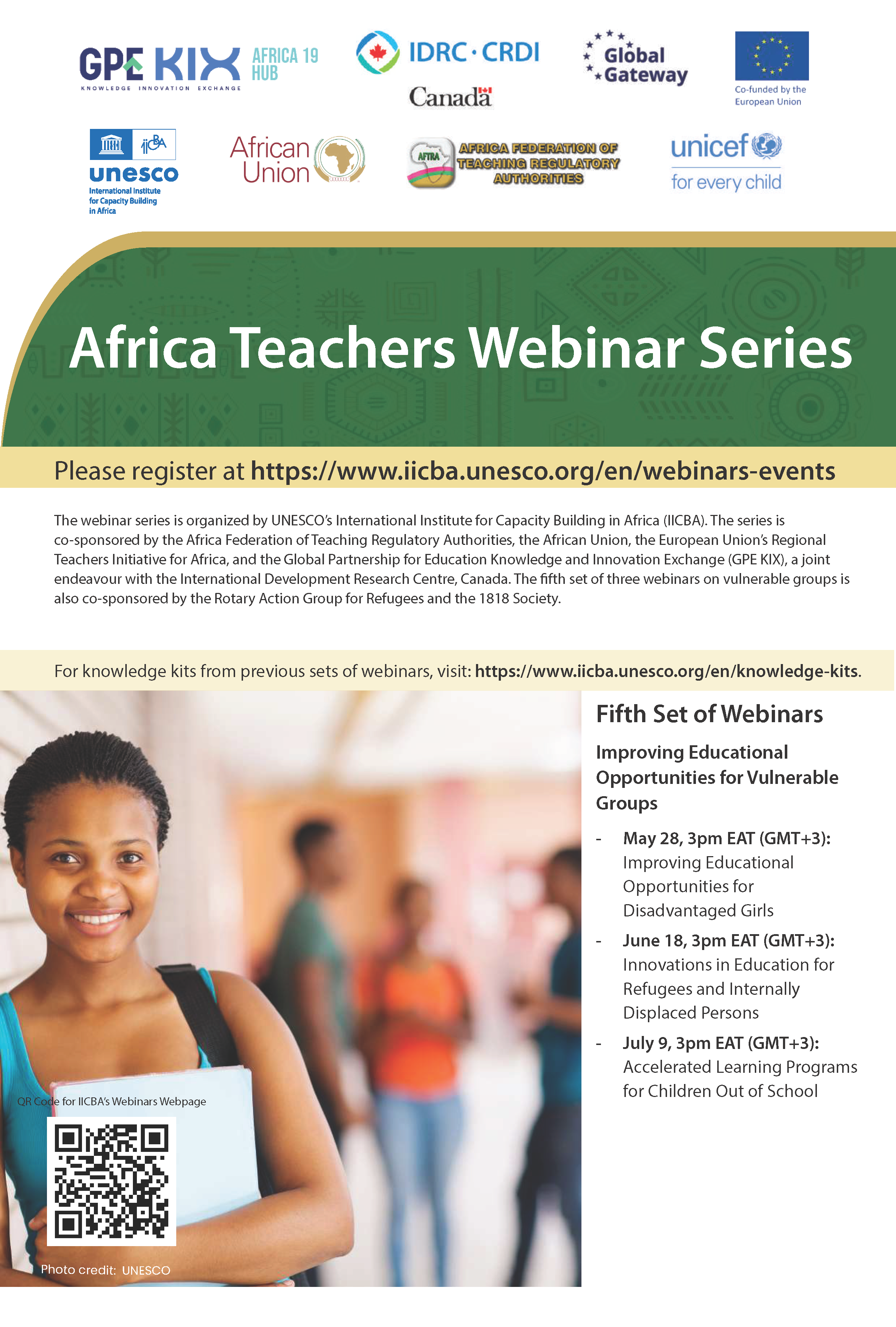
5th Africa Teachers Webinar Series: Supporting teachers to reach vulnerable learners

A new webinar series is bringing together policymakers, practitioners and partners to explore how education systems across Africa can better support vulnerable learners, through stronger teaching and more inclusive classroom practices.

Organized by UNESCO’s International Institute for Capacity Building in Africa (IICBA) and co-sponsored by regional and global partners, the Africa Teachers Webinar Series places teachers at the centre of efforts to deliver more inclusive and equitable education.

The fifth set of webinars, Improving Educational Opportunities for Vulnerable Groups, will take place over three sessions:

  • 28 May (3:00 PM EAT) – Disadvantaged girls
  • 18 June (3:00 PM EAT) – Refugees and internally displaced persons
  • 9 July (3:00 PM EAT) – Out-of-school children

Across the series, discussions will highlight how teachers can adapt their practice, respond to diverse learning needs, and play a critical role in reaching those furthest behind, from crisis-affected contexts to learners at risk of exclusion.

By sharing practical approaches and policy insights, the webinars aim to strengthen teacher capacity and support more inclusive classrooms across the region.
 

👉 Register: https://www.iicba.unesco.org/en/webinars-events
 

Event
  • 23.04.2026

5th Africa Teachers Webinar Series: Supporting teachers to reach vulnerable learners

A new webinar series is bringing together policymakers, practitioners and partners to explore how education systems across Africa can better support vulnerable learners, through stronger teaching and more inclusive classroom practices.

Organized by UNESCO’s International Institute for Capacity Building in Africa (IICBA) and co-sponsored by regional and global partners, the Africa Teachers Webinar Series places teachers at the centre of efforts to deliver more inclusive and equitable education.

The fifth set of webinars, Improving Educational Opportunities for Vulnerable Groups, will take place over three sessions:

  • 28 May (3:00 PM EAT) – Disadvantaged girls
  • 18 June (3:00 PM EAT) – Refugees and internally displaced persons
  • 9 July (3:00 PM EAT) – Out-of-school children

Across the series, discussions will highlight how teachers can adapt their practice, respond to diverse learning needs, and play a critical role in reaching those furthest behind, from crisis-affected contexts to learners at risk of exclusion.

By sharing practical approaches and policy insights, the webinars aim to strengthen teacher capacity and support more inclusive classrooms across the region.
 

👉 Register: https://www.iicba.unesco.org/en/webinars-events
 

Event
  • 21.04.2026

Strengthening teaching practice through evidence: Webinar on pedagogical practices in Latin America and the Caribbean

SUMMA and the Organisation of Eastern Caribbean States, through the KIX LAC Hub and with support from the Global Partnership for Education and Canada’s International Development Research Centre, will host a webinar on Thursday, 30 April as part of a Knowledge Mobilization Cycle on the use of evidence in teacher policies and practices.

The session will focus on classroom teaching and effective pedagogical practices, examining how to strengthen teaching in response to persistent gaps in foundational learning across Latin America and the Caribbean. It will bring together perspectives from ministries of education, teacher education institutions and regional organizations, with practical insights from diverse country contexts.

The webinar is intended for government representatives, academic institutions and education stakeholders working to improve the quality and inclusiveness of education systems.
 

Event details

Date: Thursday, 30 April
Time: 11:00–12:30 (Santiago, Chile, GMT-4)
(Please check your local time)

Register your participation here.


Agenda highlights

Opening and welcome

  • Pedro Garret, KIX LAC Hub, SUMMA

Effective practices and innovation for foundational learning

  • Rafael Carrasco, SUMMA

Quality teaching and regenerative education models

  • Rafer Gordon, OECS

Panel: Improving pedagogical practice in challenging contexts

  • Honduras: Applied research for transforming teaching practice
  • Saint Vincent and the Grenadines: Teacher education in crisis contexts
  • Guatemala: Pedagogical practice within the National Literacy Strategy

Interactive dialogue and closing remarks
 

This session will contribute to ongoing efforts to connect evidence, policy and practice, supporting teachers to respond to diverse classroom realities and improve learning outcomes.

Brochure / Flyer
  • pdf
  • 20.02.2026

RTIA Posters Window 2 Crisis Contexts

This set of posters presents the key results of projects funded under the Regional Teachers Initiative for Africa (RTIA), supporting teachers in crisis-affected contexts across Burkina Faso, Uganda...
Brochure / Flyer
  • pdf
  • 20.02.2026

RTIA Posters Window 2 Crisis Contexts

This set of posters presents the key results of projects funded under the Regional Teachers Initiative for Africa (RTIA), supporting teachers in crisis-affected contexts across Burkina Faso, Uganda...
Brochure / Flyer
  • pdf
  • 20.02.2026

RTIA Factsheets Window 2 Crisis Contexts

a { text-decoration: none; color: #464feb; } tr th, tr td { border: 1px solid #e6e6e6; } tr th { background-color: #f5f5f5; } This document presents a set of initiatives implemented under the Regional...