Meeting document
  • pdf
  • 10.09.2025
  • FR  |  ES

Santiago Consensus

The World Summit on Teachers, hosted by UNESCO and the Government of Chile, successfully took place in Santiago de Chile on 28-29 of August, culminating in the adoption of the Santiago Consensus...
Event
  • 09.09.2025

2025 IIEP Strategic Debate #3: Reducing the teacher gap and planning for equitable teaching

Teachers are at the heart of the learning process and play a critical role in reducing learning inequalities. Yet, according to UNESCO, an estimated 44 million teachers are still required to reach the goal of universal primary and secondary education by 2030, including 15 million in sub-Saharan Africa alone. Despite this clear need, education authorities continue to struggle with attracting and keeping qualified teachers. 

This debate will review techniques and policies currently piloted in different contexts to reduce the teacher gap, improve teacher professional development, and plan for more equitable teaching, building on recent research produced on the topic.

Moderator:

  • Martín Benavides, Director, UNESCO's International Institute for Educational Planning (IIEP-UNESCO)

Speakers:

  • Shem Okore Bodo, Senior Programs Officer, Association for the Development of Education in Africa
  • Gregory Elacqua, Principal Economist in the Education Division, Inter-American Development Bank
  • Dhir Jhingran, Founder Director, Language and Learning Foundation
  • Kraiyos Patrawart, Managing Director, Equitable Education Fund
  • Barbara Tournier, Programme Specialist, IIEP-UNESCO

Register for the event here.

Event
  • 09.09.2025

Rural teachers in the Asia Pacific region: lessons learnt from policy implementation webinar

Please note that this event is invite only.

As nations strengthen their teacher policies, the specific conditions of rural teachers necessitate targeted policy attention. As recognized by SDG 4, teachers are fundamental for facilitating access to inclusive, equitable and quality education, with goal 4.C appealing for significant increases in teacher supply numbers. Across rural and remote contexts, education systems are struggling to attract and retain qualified teachers, whilst navigating the complex and resource constrained contexts.

To facilitate sustained progress in supporting the rural teacher workforce, TTF and INRULED are hosting a policy learning webinar for members in the Asia-Pacific region, to share knowledge regarding established and promising rural teacher policies. This session will strengthen engagement with the issues of rural teachers, prior to the official publication of the Rural Teachers Module in the Teacher Policy Development Guide (TPDG).

Webinar objectives:

  • Acknowledge and discuss the specific challenges and needs of rural teachers.

  • Generate recognition across Asia-Pacific Member States for the specific inclusion of rural/remote teacher policy attention across teacher policies.

  • Encourage meaningful exchange of rural/remote teacher policies, initiatives and schemes between speakers and participants. Share knowledge and good practices to encourage the development of sustainable rural/remote teacher policies.

  • Identify actionable solutions and policy directions that can be integrated into broader teacher policies, which address the complex issues found across rural education structures.

Key speakers:

Key speakers for the event will be announced here soon.

Register for the event here.

Blog
  • 04.09.2025

Strengthening teacher agency in the age of AI: Insights from a new position paper

As artificial intelligence (AI) reshapes classrooms around the world, a new position paper champions a simple but powerful principle: teachers, not technology, must lead this transformation. Launched by the International Task Force on Teachers for Education 2030 (TTF) during UNESCO’s Digital Learning Week, the position paper highlights how AI can be a powerful ally for teachers when guided by sound policy, ethical principles, and well-designed professional learning.

The paper, Promoting and Protecting Teacher Agency in the Age of Artificial Intelligence, emphasises that teachers must remain at the heart of education and of the emerging technologies influencing its future. It sets out how AI can ease administrative burdens, provide new teaching resources in multiple languages, support inclusive education, and help tailor learning to students’ needs if steered by teachers themselves. It calls for promoting human-centered pedagogies and safeguarding diversity by valuing teachers’ voices. Crucially, it also highlights the need to invest in teacher competencies so that educators can engage with AI critically and confidently to shape the future of learning.

“Teachers are the real drivers of innovation in education. AI can support them by creating more time for meaningful interactions with learners and by expanding access to quality resources. But it is teachers’ judgment, creativity, and empathy that nurture the relationships on which learning depends,” noted April Williamson, Director, Global Projects, at Digital Promise.

The paper also showcases emerging practices that demonstrate how AI can benefit teachers and students alike. For example, AI-powered tools are helping teachers to develop lesson plans aligned with national curricula, provide personalised feedback to learners, and translate materials into local languages to reduce barriers for second-language speakers. In contexts where there are severe teacher shortages, AI can also offer supplementary support to both teachers in the classroom and students while reinforcing, rather than replacing, the central role of qualified teachers.

The position paper reflects the shared perspectives of TTF members – policymakers, practitioners, and civil society – working across diverse global contexts. It was developed through a consultative process with the new TTF thematic group on Digital Education and AI, established in early 2025. The drafting process was led by Mutlu Cukurova, who prepared an initial version presented during a consultation webinar. Group members then enriched the draft through live discussions and written feedback, ensuring that the final paper carried the shared voice of the TTF. It emphasized the need both to mitigate risks to teachers and to strengthen their critical role in preparing the next generation to use AI safely and effectively.

The position paper was launched at Digital Learning Week at UNESCO in Paris and brought together educators and researchers from all regions to share concrete experiences. These ranged from frameworks that guide teachers in reviewing AI-generated feedback, to co-created tools that help students better define their learning needs, to large-scale programmes showing how generative AI can reduce teacher workload while strengthening inclusion in teaching practices.

“Placing teachers at the centre of AI development and adoption is not just the right thing to do, it is the only way to ensure that technology genuinely contributes to quality education. When teachers are empowered to lead on technology adoption, these tools become supports to building more equitable and resilient education systems,” affirmed Carlos Vargas, Head of the Teacher Task Force Secretariat and Chief of UNESCO's Section for Teacher Development.

By foregrounding teachers’ agency, the TTF position paper offers a practical roadmap for governments, institutions, and partners to support teachers as leaders of innovation in the age of AI. Its recommendations include governments developing comprehensive AI competency frameworks for teachers, supporting collaboration through professional networks, and aligning national policies to enable teacher agency in the digital age.

As AI continues to evolve, this new position paper makes clear that the future of education will be shaped not by technology alone, but by how effectively teachers are enabled to harness its potential. The message from Digital Learning Week is resounding: investing in teachers is the most effective way to ensure that AI contributes to quality, inclusive, and sustainable education for all.
 

Click here to read the position paper.
 

Related links

Image credit: UNESCO/Taek OH

News
  • 05.08.2025

Portuguese version of the Global Report on Teachers: Addressing Teacher Shortages and Transforming the Profession was officially launched in Brazil

This article is based on a press release from the UNESCO Office in Brasília.


On July 22, the Portuguese version of the Teacher Task Force & UNESCO Global Report on Teachers: Addressing Teacher Shortages and Transforming the Profession was officially launched in Brazil. The national event, organized by UNESCO Brazil in partnership with the Brazilian Federal Agency for Support and Evaluation of Graduate Education (CAPES), a public entity linked to the Brazilian Ministry of Education (MoE), and Fundação SM Brazil, took place in Brasília, the capital.

The launch attracted over 200 participants, including representatives from educational institutions, government bodies, academia, and basic education teachers. It provided a platform to discuss the report’s key findings and recommendations, focusing on the Brazilian context and the urgent need to address teacher shortages in basic education. The event was livestreamed and is available on the UNESCO Brazil YouTube channel, where it has already surpassed 1,700 views. Distinguished speakers included representatives from the Ministry of Education’s teacher training division, CAPES, the National Council for Scientific and Technological Development (CNPq), and the National Confederation of Education Workers (CNTE). Marlova Noleto, Director and Representative of the UNESCO Brasilia Office, delivered a speech during the opening session. A message from Carlos Vargas, Chief of the Teacher Development Section at UNESCO HQ, was presented via video. Rebeca Otero, Education Coordinator for UNESCO Brazil, moderated a panel featuring Valtencir Mendes, Chief of Education at the UNESCO Regional Office for Latin America and the Caribbean.

The event panels reflected a balance of gender and race, with special acknowledgment given to Shirley Costa, a Black woman and mathematics teacher from Brazil’s Northeast, whose inspiring work encourages girls to pursue studies in STEM fields.

In terms of localization efforts, UNESCO Brazil also presented the report at one of the largest educational events in the country. In addition to the national launch, Rebeca Otero, UNESCO Brazil Education Coordinator, presented the report at the 20th National Forum of UNDIME, another significant educational event held in Salvador, Bahia. This forum gathered over 3,200 participants, primarily municipal secretaries of education, who play a key role in implementing teacher-related public policies across Brazil. The broader dissemination of the report’s findings helped stimulate critical dialogue on transforming the teaching profession and reinforced the importance of coordinated efforts to ensure quality education for all.

Information and resources

Photo credit: Julia Prado - CGCOM/CAPES
Event
  • 25.07.2025

Teacher Task Force Regional Policy Learning Webinar 1: Costing Teacher Policies in the Arab Region

Please note that this event is restricted to the members of the Teacher Task Force Arab States Regional Group and UNESCO RCQE.

In the framework of its Arab States Regional Group activities, the Teacher Task Force (TTF) is organizing a webinar on “Regional Policy Learning Webinar 1: Costing Teacher Policies in the Arab Region” in collaboration with the UNESCO Regional Center of Quality and Excellence in Education.  

Taking place virtually on Thursday, July 31, 2025, the webinar will address the topic of teacher policy costing in preparation for the official launch of the Costing Module of the UNESCO & Teacher Task Force Teacher Policy Development Guide (TPDG). TTF members from the Arab States region will have the opportunity to provide insight regarding the financing of the teaching profession and present practical country examples. 

Webinar objectives:

  • Introduce key concepts and methodologies in teacher policy costing, ahead of the launch of the TPDG Costing Module; 

  • Share preliminary findings and recommendations from the upcoming UNESCO & Teacher Task Force background paper on teacher financing; 

  • Highlight country experiences from Libya, Jordan, Lebanon and Mauritania to provide practical insights and lessons; 

  • Facilitate regional dialogue on cost-sensitive and financially sustainable teacher policies; 

  • Build momentum toward national capacity-building and the integration of costing into policy development, in the lead-up to the 2025 World Summit on Teachers in Chile. 

Key speakers for the event include:

  • Carlos Vargas, Chief of the Teacher development section, UNESCO and Head of the Teacher Task Force Secretariat 

  • Abdul Rahman Almedaires, Director of UNESCO | UNESCO RCQE, KSA 

  • Ibrahim Alhussein, Director of Educational Excellence Department (Teacher Policies in Arab Countries: Investing in Quality and Foreseeing the Future), UNESCO RCQE, KSA 

  • Mohammad Momani, Director, Educational Supervision and Training Department (Cost Analysis of teachers' training), Jordan 

  • Mohamed Ibrahim Gomaa, Director, General Centre for Training and Education Development (Estimating the Costs of Teacher Policy in Libya), Libya 

  • Hana Addam, Beirut office, on teacher workforce planning and reform in Lebanon (salaries reform in Lebanon) 

  • Elhadj Rabani, Rabat Office, to discuss the simulation modelling in Mauritania 

The webinar will bring together ministers, international organizations and TTF members from the Arab region for high-level dialogue on the importance of integrating costing into teacher policy development. The webinar will be conducted in Arabic only, with the exception of a brief introduction from the Secretariat in English.

If you are a TTF member from the TTF Arab States Regional Group and have not yet received your invitation for the event, please contact Mirna Eskif at m.eskif@unesco.org. 

Blog
  • 18.06.2025

Teachers are at the center of the new Continental Strategy for Education in Africa 2026 to 2035 (CESA 26-35)

This blog post is co-authored by Sophia Ashipala, Head for Education at the African Union Commission, and Quentin Wodon, Director of UNESCO’s International Institute for Capacity Building in Africa.
 

Education remains a top priority for Africa. As part of work carried under the Year of Education in 2024, the African Union conducted a review of the Continental Education Strategy for Africa 2016-2025 (CESA 16-25) and prepared a new strategy for 2026-2035 (CESA 26-35). The new strategy was approved at the African Union’s summit in February 2025 and is now available on the website of the African Union. Separately, the African Union also approved a new strategy for Technical and Vocational Education and Training (TVET), also now available online.

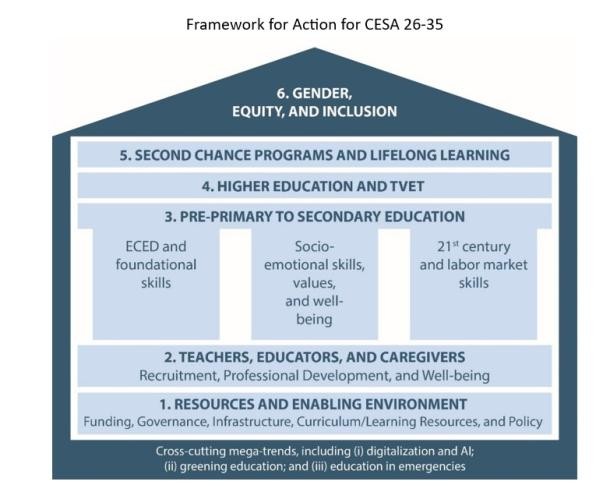
CESA 26-35 comprises of four parts: (1) A brief investment case; (2) A review of selected challenges; (3) A framework for action; and (4) A discussion on governance, communications, and monitoring. Part I for the investment case considers (i) Human rights, peace and sustainable development, including considerations related to gender, equity, and inclusion; (ii) Health and social benefits; and (iii) Labor market benefits. Part II reviews progress (or the lack thereof) for schooling and learning, as well as the links between both. It also provides a summary of key findings from the CESA 16-25 review. Part III is the core of the strategy. It provides a framework for action with six strategic areas of focus and 20 objectives. Part IV is about governance, communications, and data for monitoring and evaluation (M&E).

Teachers are at the core of CESA 26-35, with three objectives under the second strategic area in the strategy that focuses on teachers. These three objectives are: (1) Improve teacher policies, education, professional development, and accountability; (2) Increase the attractiveness of the teaching profession; and (3) Invest in school leadership including the share of female leaders where needed. The other five strategic areas under CESA 26-35 focus on (i) Resources and the enabling environment; (ii) Pre-primary to secondary education, with a focus on early learning and foundational, socio-emotional, and 21st century and labor market skills; (iii) Higher Education and TVET; (iv) Second chance programs and lifelong learning; and (v) Gender, equity, and inclusion. Several cross-cutting themes are also mentioned, including (1) digitalization and AI; (2) greening education; and (3) education in emergencies.

A simple visual aims to facilitate communications around strategic areas. The Figure below conveys the idea that education systems must be built, like a house or structure. The first two strategic areas, including the area focusing on teachers, are the foundations, followed by three pillars combined into one strategic area. These pillars relate to the foundational, socio-emotional, and 21st century skills that learners must acquire, especially through pre-primary to secondary education. Those skills also need to be emphasized at higher levels of learning, as well as in second chance programs and lifelong learning, but the period from pre-primary to secondary education is essential. Next come educational opportunities through Higher Education and TVET, and programs for children and youth out of school and for lifelong learning for adults. The roof and outside walls that encompass the whole system must ensure gender-transformative approaches, equity, and inclusion. Finally, the text at the base of the structure highlights a few critical mega-trends that education systems must adapt and respond to.

FrameworkforactionforCESA.jpg

In total, CESA 26-35 has 20 objectives, a smaller than the Action Areas (AAs) in the previous strategy for 2016 to 2025 (CESA 16-25), in part to convey prioritization. For each objective, the strategy provides a brief explanation of the importance of the objective and links to guidance related to promising interventions and approaches for achieving the objective. UNESCO IICBA played an important role in working with the African Union to draft the strategy and conduct an extensive consultation process before its approval.

As CESA 26-35 is now approved and available online, the next steps will consist in planning its dissemination and implementation. A first implementation meeting with members of the CESA task force was organized in Nairobi in May 2025. On matters related to teachers, the CESA teacher professional development cluster is in the process of providing additional guidance. For example, along CESA 26-35, a separate strategy was adopted by the African Union on mental health and psycho-social support (MHPSS) for teachers in Africa.

In future articles for this newsletter, we will provide more details on the MHPSS strategy and the broader implementation plans for CESA 26-35, especially as they pertain to the teaching profession in Africa.

Event
  • 05.06.2025

Teacher Task Force to present at Leeds Beckett University international conference on global teacher education

The Teacher Task Force will take part in the inaugural international conference Global Perspectives in Teacher Education: Challenging the Standard Education Model, hosted by Leeds Beckett University's Carnegie School of Education in collaboration with the British Educational Research Association.

The Teacher Task Force Secretariat will contribute to the programme through two sessions:

  • A presentation on the 2024 Global Report on Teachers: Addressing Teacher Shortages and Transforming the Profession, sharing the report’s major findings, data insights and policy recommendations.

  • An interactive session that will contribute to the development of the upcoming 2026 Global Report on Teachers.

The conference, taking place from 26–27 June 2025 in Leeds, UK, will bring together educators, researchers, policy experts, and practitioners to explore the global impact of teacher education systems, with themes including sustainability, inclusion, diversity, curriculum reform, and global citizenship. The event aims to support the achievement of the Education 2030 goals by fostering international collaboration and generating innovative responses to the teacher recruitment and retention crisis.

The Teacher Task Force’s contributions will highlight how global evidence and shared learning can inform national and international efforts to strengthen teacher policy and build more equitable, resilient, and future-ready education systems.

More information and registration
👉 Register here
📍 Leeds Beckett University, UK
📅 26–27 June 2025

Event
  • 14.05.2025

Teacher Task Force to launch Arabic version of the Global Report on Teachers at GESS Saudi Arabia 2025

The International Task Force on Teachers for Education 2030 will participate in the Saudi Arabia Global Educational Supplies and Solutions (GESS) conference 2025 a major international education exhibition and conference taking place in Riyadh from 26-28 May 2025.

As part of the opening high-level session on 26 May, the Teacher Task Force will launch the Arabic version of the Global Report on Teachers, entitled Addressing teacher shortages and transforming the profession, which has been translated into Arabic and published in collaboration with UNESCO and the UNESCO Regional Centre for Quality and Excellence in Education (RCQE).

A representative of the Teacher Task Force Secretariat will present key findings and recommendations from the report to an audience of key education experts and decision-makers from the Kingdom of Saudi Arabia, the wider region, and across the globe. The session will focus on the urgent need to transform the teaching profession and address teacher shortages through informed policies and strategic investment. This high-level event forms part of a wider programme of activities at GESS Saudi Arabia aimed at anticipating the future of education and fostering international cooperation.

The Teacher Task Force’s participation reflects its continued commitment to supporting countries in building stronger teacher policies and systems through global knowledge sharing and regional engagement.