Blog
  • 21.01.2026

Our 2025 wrapped: Reflecting on the TTF’s impact for teachers

2025 marked a year full of engaging opportunities, fruitful discussions, and productive advancements towards achieving SDG 4 target 4.c through the work of the Teacher Task Force (TTF), especially amid ever-changing geopolitical shifts. Activities in 2025 continued to be structured around knowledge production and dissemination, advocacy, and national and regional policy learning, marking the final year of our 2022-2025 Strategic Plan.

Month to month, the TTF raised awareness and expanded knowledge across key issues concerning teachers: from building AI competencies to promoting collaboration to advocating for greater financing of the teaching profession.

Moving with the same momentum into 2026 and beginning of a new Strategic Plan cycle, the TTF enters another year full of meaningful dialogue, reflection and stocktaking around innovative policies, and global action aimed at improving teachers’ working conditions, education and well-being. As the year comes to an end, it is important to reflect on the accomplishments from 2025 that will set the pace for the upcoming year.

Global efforts propelling the teaching agenda

The TTF participated in dozens of global events prioritizing sustainable teacher development initiatives, ultimately leading to one of the largest initiatives of the year, the World Summit on Teachers in Santiago de Chile. Building on the 2024 Global Report on Teachers (GRT) and the 14th Policy Dialogue Forum (PDF), the Summit culminated in the adoption of the Santiago Consensus, which was developed collaboratively under the auspices of UNESCO and the TTF, the SDG4-Education 2030 High-Level Steering Committee, youth networks, teachers and organizations. At its core, the Santiago Consensus underscores the indispensable role of teachers in education systems worldwide and recognizes the key role that the TTF plays and should play in fostering teacher policy development and implementation.

Chile

Youth engagement formed part of the TTF’s wider advocacy and partnership work in 2025. Collaboration with the SDG4 Youth & Student Network supported dialogue around the Santiago Consensus and broader global exchanges on addressing teacher shortages and transforming the profession into one that is respected and empowered.

World Teachers’ Day served as another successful opportunity to advocate for teachers. This year’s theme, “Recasting teaching as a collaborative profession,” illustrated the significance of collaboration among teachers, an invaluable facet that will characterize the profession moving forward. The 2025 World Teachers’ Day fact sheet sheds more light on ever-evolving trends in the teaching profession and examines how to cultivate collective thinking.

Informing policy creation through knowledge products and reports

The vast knowledge produced by the network continued to spearhead advocacy campaigns and played an influential role in informing political decisions aimed at improving teacher conditions, beginning with further dissemination of the 2024 Global Report on Teachers. The TTF successfully launched the Portuguese version of the report in Brasília and the Spanish version through three national launches in Madrid, Seville and Valencia, as well as a regional launch in Chile for Latin America, strengthening advocacy efforts at both regional and national level. In parallel, work advanced on the forthcoming 2026 edition through Editorial Board meetings.

New evidence also emerged this year, such as Costing and financing the teaching profession: A strategic investment in education, a paper offering strategic guidance for governments and education stakeholders on funding the profession. Promoting and protecting teacher agency in the age of artificial intelligence and its quick guide are that support understanding of major advances in artificial intelligence (AI) and how these can be adapted to teachers’ needs. Both papers set the course for the future of the education agenda, highlighting strategies to finance the teaching profession and analyzing the role of AI in classrooms.

New Evidence

Developed in line with World Teachers’ Day 2025, the World Teachers’ Day fact sheet, published by the TTF and UNESCO Institute for Statistics (UIS), highlights new trends and data related to the teaching profession and how these insights can support continuous professional development.

The TTF further contributed to knowledge generation through its participation in the APPRENDRE international seminar in Dakar in October 2025, where the Secretariat shared key highlights from a forthcoming paper on Teacher Management Information Systems (TMIS) in sub-Saharan Africa, underscoring the role of reliable teacher data in supporting effective planning and evidence-based policymaking.

Continuing to advocate for inclusive education

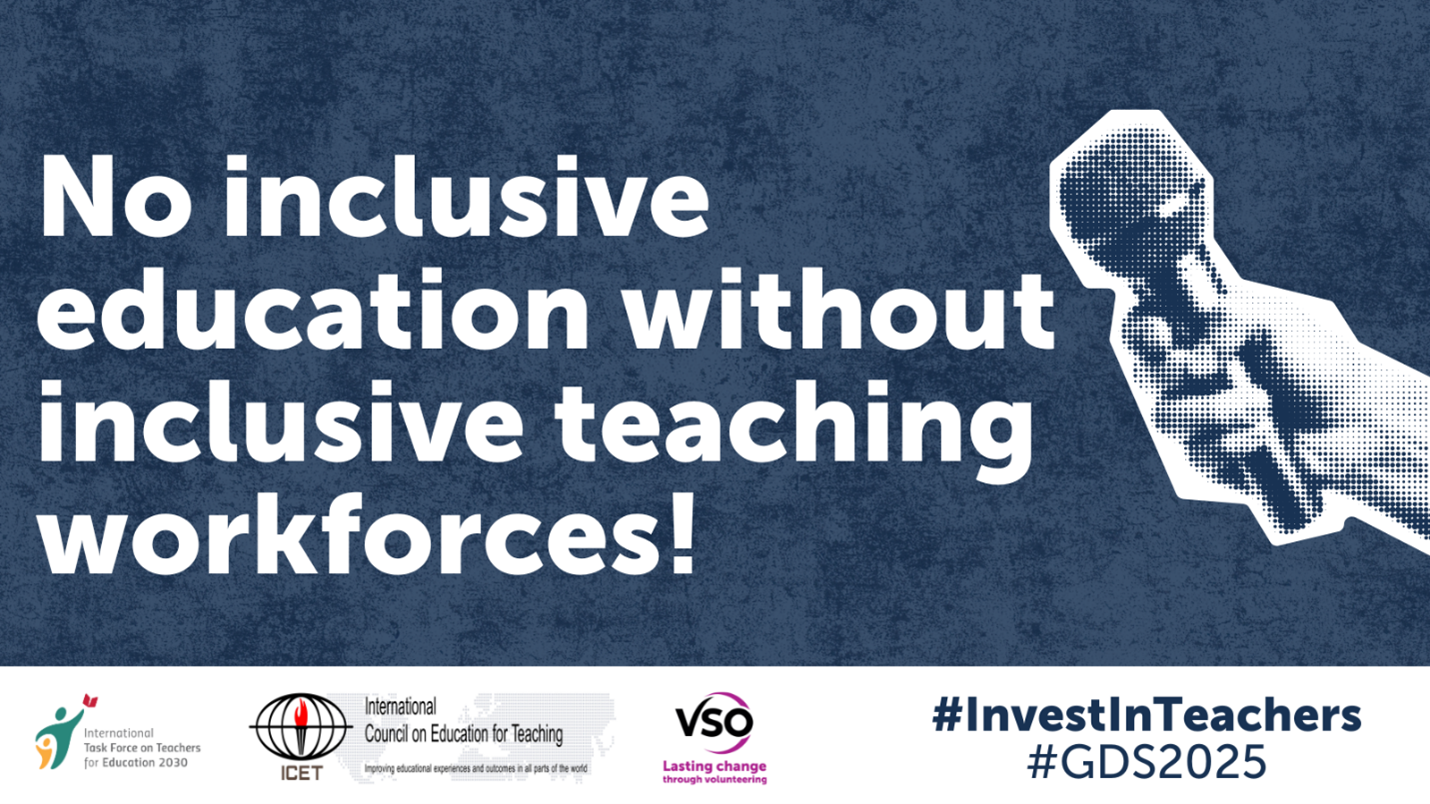
Inclusive education was a major theme in the work of the TTF this year, playing a part in multiple events, such as the Global Disability Summit and International Day of Persons with Disabilities. The advocacy campaign Teachers without limits: Voices we must hear, leaders we must follow, led by the TTF’s Thematic Group on Inclusion and Equity in Teacher Policies and Practices, exemplified member-led collaboration by amplifying the leadership and lived experiences of teachers with disabilities through blogs, interviews and social media.

Inclusive

In parallel, the TTF continued its engagement in youth-led advocacy around the Santiago Consensus, ensuring sustained attention to its core messages on inclusive and equitable education.

Supporting teacher policies at a national and regional level

The Teacher Policy Development Guide (TPDG) continued to support evidence-informed teacher policies, helping ensure that every learner is taught by qualified, trained and well-supported teachers. Regional webinars included a policy learning webinar in the Asia-Pacific region, co-organized with INRULED, focused on rural teacher policies and lessons from implementation, as well as a regional webinar for Arab States – facilitated by RCQE – on the costing and financing of teacher policies, with insights feeding into the development of new TPDG modules.

Looking ahead at 2026

With all the transformative work from 2025 paving the way, the year ahead will continue to foster inclusive, equitable, and quality opportunities for teachers through policy dialogues, reports, advocacy campaigns, and global events. Major milestones will include the release of the 2026-2029 Strategic Plan and the next edition of the Global Report on Teachers, as well as ongoing dissemination and contextualization of the Santiago Consensus.

The TTF offers a warm thank you to its members and partners for their collaboration and unwavering support towards realizing SDG 4. As we embark on a new year, it is critical to recognize the contributions of the network and commitment to bettering the teaching profession.

To learn more about the many accomplishments of the TTF and its members this past year, explore our blogs and subscribe to our newsletter.

2026 upcoming highlights:

Blog
  • 08.10.2025

Costing and financing the teaching profession: What you need to know

Costing and financing the teaching profession: a strategic investment in education, a paper co-published by the International Task Force on Teachers for Education 2030 and UNESCO at the World Summit on Teachers, examines the challenges and opportunities associated with sustainable financing of the teaching profession, highlighting the relevance of salary structures, workload, international aid, and innovative funding.

What are the key findings regarding the costing and financing of the teaching profession?

The report addresses the mounting crisis in the teaching profession, revealing that the global education community is off-track to achieve Sustainable Development Goal 4 (SDG 4), partially due to education financing gaps. The need for 44 million primary and secondary teachers still persists, and new calculations estimate that new teacher salaries will come at a cost of US $120 billion annually. Fiscal austerity on education budgets has impacted teacher financing, leading to severe restrictions in public sector wage bills in over 30 African and Asian countries. Ending the global teacher shortage demands comprehensive, long-term investment strategies that promote equitable recruitment, fair remuneration, continuous professional development, and better working conditions.

What role does debt play in education financing?

The principal source of education financing comes from domestic public expenditure. While 52 countries have increased their education budgets in 2021, 32 countries reduced theirs because of rising debt servicing obligations. The UN’s Human Rights Council warns that 3.3 billion people live in countries where governments spend more on debt repayments than on essential public services, including education and healthcare. Debt-related solutions include debt swaps, which reduce a proportion of debt in exchange for reinvestments in different sectors, such as education.

Why is it necessary to advocate for the continuous professional development of teachers in the midst of a global teaching crisis?

Continuous professional development (CPD) often can compensate for insufficient initial teacher education and is a necessary tool for improving teaching skills, education quality and outcomes. Because many countries, particularly in low- and middle-income contexts, struggle to invest in effective initial teacher education, it is essential to provide ongoing training and opportunities that rectify this. Neglecting CPD in public financing perpetuates disparities in teaching quality, therefore reinforcing educational inequalities. In Sub-Saharan Africa, CPD constitutes less than 2% of total recurrent education expenditure, resulting in reliance on donor-dependent training programmes, which are often less coherent and sustainable.

How has international aid contributed to supplementing domestic education budgets?

International aid has historically been crucial in supplementing domestic education budgets, particularly for teacher recruitment, training, and salary support in low- and middle-income countries (LMICs) through budget support, core funding, technical assistance, and pooled funds. However, donor preferences tend to favor short-term, measurable outcomes over systemic investments, resulting in a proliferation of smaller training initiatives. Donor coordination and accountability should be structured in a manner that aligns with national plans, strengthens teacher welfare, and boosts system efficiency.

What role do public-private partnerships play in teacher funding?

Public-private partnerships (PPPs) are collaborative agreements between government entities and private sector companies to finance, build, and operate projects that serve the public. In the context of global education financing, there has been an increase of PPPs that extend into teacher recruitment, training, and remuneration. While PPPs are intended to expand access, improve efficiency, introduce innovation, and compensate for resource constraints within public education systems, they frequently prioritize cost efficiency over pedagogical quality and labour rights. Therefore, it is vital to scale PPP arrangements under stringent public oversight and in alignment with national education plans and teacher protections.

What are the major challenges involved in the costing of the teaching profession?

Teacher shortages have proven to be one of the most critical challenges, exacerbated by demographic trends such as aging teacher cohorts, gender imbalances, and uneven geographic deployment. These elements both fuel a greater demand for teachers and increase the cost of recruitment and workforce stabilization, eliciting fiscal restrictions and financial and logistical bottlenecks. Teacher attrition presents one of the most significant financial burdens, as high turnover rates incur substantial recruitment, induction, and training costs. The problem of reducing the cost of teacher deployment while bettering working conditions and advocating for continuous professional development remains one of the largest within the field. 

How can governments address financing for teachers?

There are several effective ways that governments can appropriately address financing for teachers, including:

  • Mobilizing domestic resources for teachers by prioritizing education in national budgets;
  • Enshrine legal safeguards for education financing through a legally mandated minimum budget allocation;
  • Invest in high-quality ITE and CPD that is accessible for all teachers and linked to career progression;
  • Develop robust data systems and funding tools such as education accounts, integrated payroll systems, and workforce simulation models.
  • Further explore PPPs and innovative financing methods, ensuring transparent governance with national education priorities.

What are the recommendations for donors and international partners?

Donors and international partners are encouraged to participate in the following ways:

  • Coordinating donor funding within sector-wide approaches to minimize fragmentation;
  • Supporting domestic resource mobilization and debt relief through assisting governments in progressive tax policy reforms and debt management negotiations.
  • Promoting capacity building for workforce planning by investing in effective costing tools, data systems, and policy frameworks.

How can teachers, teachers’ unions, and other stakeholders support sustainable financing for teachers?

Teachers, teachers’ unions, and other stakeholders all play a unique role in advocating for sustainable financing for teachers and are urged to abide by the following recommendations:

  • Proactively engaging in national and local education policy dialogue;
  • Collaborating with governments to co-design competency-based career frameworks and professional development standards;
  • Promoting collective bargaining for equitable salary structures, comprehensive benefits, and protection against precarious employment arrangements;
  • Building partnerships with communities and fostering peer support and mentoring networks.

Access the full paper here.

Read the summary of key messages here.


Meeting document
  • pdf
  • 10.09.2025
  • FR  |  ES

Santiago Consensus

The World Summit on Teachers, hosted by UNESCO and the Government of Chile, successfully took place in Santiago de Chile on 28-29 of August, culminating in the adoption of the Santiago Consensus...
Blog
  • 29.07.2025

Financing sustainable development: the cost of closing the teacher gap

The future of sustainable education is largely reliant on the ability to fund it; however, the gap between sustainable development aspirations and financing to meet them has widened, reaching an estimated US$4 trillion annually. This has trickled down to impact how countries budget for education, ultimately affecting the opportunities provided by the teaching profession. Now more than ever, it is essential to invest in teachers and ensure accessible and equitable education for generations to come. 


The Fourth International Conference on Financing for Development took place from 30 June to 1 July 2025 in Sevilla among Heads of State and Governments, gathering with the goal of renewing their shared commitment to the 2030 Agenda for Sustainable Development and its 17 Sustainable Development Goals (SDG) reflected in the Compromiso de Sevilla.

Education, culture, and scientific research are among the most powerful levers for peace and the development of our societies. Ensuring sustainable funding for them is now essential—undermining it would mean undermining our shared future. - Audrey Azoulay (UNESCO Director-General) 

Yet, in this conversation of sustainable development, many key areas were not acknowledged, such as SDG 4 and specifically target 4.c: By 2030, substantially increase the supply of qualified teachers, including through international cooperation for teacher training in developing countries, especially least-developed countries and small island developing States. The event glossed over difficulties in funding sustainable education and failed to outline concrete plans to overcome such problems. Instead, it took a broad approach in advocating for sustainable development as a whole, not necessarily going into the details of what sustainable development consists of. 

Education is a necessary component of sustainability plans. A recent UNESCO report highlights that a deficit in basic skills will cost the global economy potentially US$10 billion annually by 2030. Still, continuous financial obstacles, such as rising trade tensions and sovereign debt, serve as a barrier to addressing this deficit. In response to this, leaders at the conference outlined a detailed agenda calling for stronger financial transparency regarding sustainable development generally. 

Debt as a roadblock towards equitable education 

The discussion surrounding debt must be taken into consideration as an element of funding education. Amid successive global crises, sovereign debt has challenged the notion of sustainable development, and therefore the future of education. The UN Trade and Development found that more than 40% of the world’s population live in countries where more is spent on debt interest payments than education or health.  

“There is an alarming tendency among the international community to regard debts in the developing world as sustainable because they can, after some sacrifice, be paid off,” says UN Trade and Development Secretary-General Rebecca Grynspan. “This view overlooks the skipped meals, forgone investments in education, and lack of public health spending, not to mention reduced investment in infrastructure, that forcibly make room for interest payments.” 

Inadequate financing threatens global sustainable development through escalating education inequalities and reducing learning opportunities; the debt crisis is largely responsible for the lack of monetary attention to education. With this, the United Nations Secretary-General is requested to convene a group working with the International Monetary Fund and the World Bank assigned to establish guiding principles on responsible sovereign borrowing and lending.   

Closing the digital divide in education 

In addition to financial obstacles, the rapid and unprecedented advancement of science, technology and innovation has also inhibited developing countries’ ability to maximize potential for sustainable development, as it has deepened digital divides both between and within countries. Unintended economic, environmental, and social impacts have worsened gender inequality and further excluded persons with disabilities, older persons, and those in vulnerable situations. 

The Compromiso de Sevilla states: “We will take action to leverage the positive impacts of digitalization in education and reaffirm our commitment to foster innovation, financial literacy and digital capacity building, including through education and skills development.” 

In education, the digital divide persists. Today, 2.6 billion people still lack access to the internet, or about 32% of the global population. That number increases to 60% of primary schools globally that are not connected to the internet. Therefore, the support of developing and deploying technologies that are affordable, available, equitable, and accessible to all is of utmost importance. Leaders from the conference advocate for financing plans that invest in digital infrastructure across societies while continuing to enhance STEM skills among children, youth, women and girls, persons with disabilities, and people in vulnerable situations. 

Investing in the development of teachers 

Investing in education requires investing in teachers, and that implies salary costs and professionalization initiatives. According to the 2024 Teacher Task Force & UNESCO Global Report on Teachers, the urgent need for 44 million primary and secondary teachers worldwide comes at a cost of US$12.8 billion for universal primary education and US$106.8 billion for universal secondary education. Funding towards maintaining strong salaries and enhancing working conditions is not only essential in retaining existing teachers, but also in attracting qualified candidates to fill these missing positions. Teacher attrition is an exceedingly significant financial cause because high turnover rates require additional investment in recruiting and training new teachers. 

Despite its recognized importance as a sustainable development indicator, education and the role of teachers were overlooked throughout the conference. The only reference to education as an element of development was a vague commitment to supporting “adequate financing to ensure inclusive, equitable, and quality education for all.” Yet, the implications are clear: without adequate financial planning, reaching the 2030 SDGs in education will be nearly impossible.  In the discussion of financing for the future of sustainability, the inclusion of education and teachers needs to be better addressed. 

The World Summit on Teachers 

The upcoming World Summit on Teachers presents an opportunity to further discuss the funding of the teacher profession through exploring potential partnerships, innovative financing mechanisms, and different funding strategies. Led by UNESCO and the Government of Chile, the event will take place in Santiago, Chile, on 28 and 29 of August 2025. In conjunction with the Summit, UNESCO and the International Task Force on Teachers for Education 2030 will be publishing a paper about the costing and financing of teachers, emphasizing the need for bold investments and increased education budgets. The report further stresses the necessity of reversing high teacher turnover rates, which disproportionately affect low-income and marginalized communities. Check back soon to read the full paper. 

Learn more 

Event
  • 25.07.2025

Teacher Task Force Regional Policy Learning Webinar 1: Costing Teacher Policies in the Arab Region

Please note that this event is restricted to the members of the Teacher Task Force Arab States Regional Group and UNESCO RCQE.

In the framework of its Arab States Regional Group activities, the Teacher Task Force (TTF) is organizing a webinar on “Regional Policy Learning Webinar 1: Costing Teacher Policies in the Arab Region” in collaboration with the UNESCO Regional Center of Quality and Excellence in Education.  

Taking place virtually on Thursday, July 31, 2025, the webinar will address the topic of teacher policy costing in preparation for the official launch of the Costing Module of the UNESCO & Teacher Task Force Teacher Policy Development Guide (TPDG). TTF members from the Arab States region will have the opportunity to provide insight regarding the financing of the teaching profession and present practical country examples. 

Webinar objectives:

  • Introduce key concepts and methodologies in teacher policy costing, ahead of the launch of the TPDG Costing Module; 

  • Share preliminary findings and recommendations from the upcoming UNESCO & Teacher Task Force background paper on teacher financing; 

  • Highlight country experiences from Libya, Jordan, Lebanon and Mauritania to provide practical insights and lessons; 

  • Facilitate regional dialogue on cost-sensitive and financially sustainable teacher policies; 

  • Build momentum toward national capacity-building and the integration of costing into policy development, in the lead-up to the 2025 World Summit on Teachers in Chile. 

Key speakers for the event include:

  • Carlos Vargas, Chief of the Teacher development section, UNESCO and Head of the Teacher Task Force Secretariat 

  • Abdul Rahman Almedaires, Director of UNESCO | UNESCO RCQE, KSA 

  • Ibrahim Alhussein, Director of Educational Excellence Department (Teacher Policies in Arab Countries: Investing in Quality and Foreseeing the Future), UNESCO RCQE, KSA 

  • Mohammad Momani, Director, Educational Supervision and Training Department (Cost Analysis of teachers' training), Jordan 

  • Mohamed Ibrahim Gomaa, Director, General Centre for Training and Education Development (Estimating the Costs of Teacher Policy in Libya), Libya 

  • Hana Addam, Beirut office, on teacher workforce planning and reform in Lebanon (salaries reform in Lebanon) 

  • Elhadj Rabani, Rabat Office, to discuss the simulation modelling in Mauritania 

The webinar will bring together ministers, international organizations and TTF members from the Arab region for high-level dialogue on the importance of integrating costing into teacher policy development. The webinar will be conducted in Arabic only, with the exception of a brief introduction from the Secretariat in English.

If you are a TTF member from the TTF Arab States Regional Group and have not yet received your invitation for the event, please contact Mirna Eskif at m.eskif@unesco.org.