This blog has been co-authored by Prof. Sarah Younie, CEO, MESHGuides, and April Williamson, Director of Global Projects, Digital Promise, co-leads of the Teacher Task Force Thematic Group on Digital Education and Artificial Intelligence.
Teachers are at the heart of every education system, but in many parts of the world, they lack access to quality training and professional development. According to UNESCO and the Teacher Task Force, an estimated 44 million new teachers will be needed by 2030 to achieve the SDG 4 targets. Addressing this global teacher shortage requires a holistic approach, including training and accreditation systems that build professionalism and effectively support and develop teachers throughout their careers. Yet in many contexts — particularly those affected by crisis, limited infrastructure, and scarce resources — conventional training models fail to reach those who need them most.
The COVID-19 pandemic further highlighted the urgent need to equip large numbers of teachers with both foundational and 21st-century skills that are critical for lifelong learning and resilient societies. Teachers must be qualified, supported, and motivated — not only to provide quality teaching today, but also to prepare students for inclusive and increasingly digital societies. This is especially urgent in low- and middle-income countries, where scalable, low-cost, and rapidly deployable solutions are needed to meet the need for large-scale, high-quality, and effective training.
In this context, low-tech and mobile approaches — such as messenger-based training — are proving to be both relevant and cost-effective. Designed to function on basic phones with minimal bandwidth, these tools offer flexible, scalable, and accessible learning opportunities that meet teachers where they are. By leveraging tools that are already used by teachers, low-tech solutions can minimize, and even reduce, workload.
A number of members of the International Task Force on Teachers for Education 2030 (Teacher Task Force, or TTF) have been at the forefront of implementing such approaches. The TTF Thematic Group on Digital Education and AI, co-led by MeshGuides and Digital Promise, hosted a webinar, “Low-Tech, High Impact: Training Teachers Where They Are”, to highlight perspectives and lessons learned from two of these scalable, mobile-based teacher training solutions: the Future Teacher Kit and ProFuturo.
Mobile-based Teacher Training: Future Teacher Kit
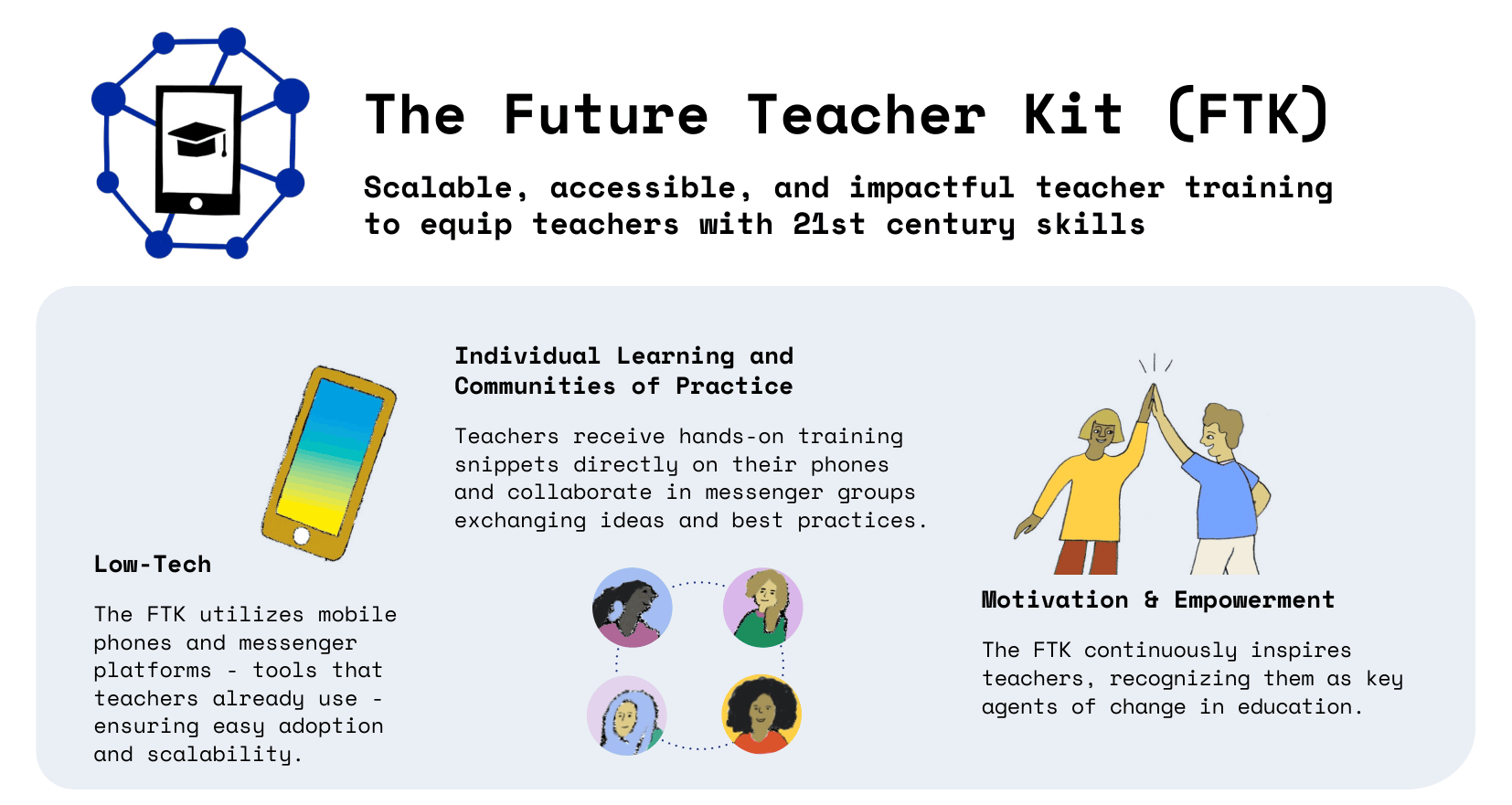
The Future Teacher Kit (FTK) is a mobile-based training approach tailored to reach teachers in a range of settings, including remote and crisis-affected areas. On behalf of the German Federal Ministry for Economic Cooperation and Development (BMZ), GIZ (Deutsche Gesellschaft für Internationale Zusammenarbeit) developed the Future Teacher Kit in collaboration with UNESCO and more than 1,500 teachers. The webinar highlighted perspectives on FTK implementation and impact from the Ministry of Education of Ecuador and the Jamaica Teaching Council, as well as GIZ, UNICEF and UNESCO.
“We know today that education systems owe teachers – not the other way around.” - Eilean von Lautz-Cauzanet, GIZ
The FTK is an adaptive, scalable professional development solution designed to prepare educators for a rapidly evolving educational landscape by improving access, fostering communities of practice, and supporting education system resilience. It uses low-tech tools with high impact, such as messenger services, to reach teachers in low-connectivity areas. Through ambassador-led, participatory communities of practice, it promotes collaboration, intrinsic motivation, and self-paced learning, while strengthening teacher networks and institutional capacity.
UNICEF joined the FTK partnership in 2024, contributing its strong expertise in digital teacher development. UNICEF has developed the Superstar Teacher Toolbox, a tool to support educators to use mobile messaging for learning, including two practical guides on digital skills and mobile pedagogy. Its content has been integrated into the FTK, leveraging the UNICEF RapidPro platform for text-based delivery. This partnership is enhancing the FTK’s scalability and pedagogical quality.
“The Future Teacher Kit reignited my love for teaching. It reminded me that I could grow, even in a digital world. It wasn't just training—it was transformation.” - FTK Cohort Participant
Competency-based Digital Skills Training: ProFuturo
As a leader in digital teacher training, ProFuturo shared complementary experiences and practical lessons from their work in low-resource contexts. ProFuturo is an education innovation programme based on technology, founded in 2016 by Telefonica Foundation and “La Caixa” Foundation.
Learning and teaching are two essential processes in today’s society. To address them holistically, ProFuturo has developed the Global Framework for Educational Competence in the Digital Era. This framework supports lifelong learning, especially for teachers, and invites the educational community to reflect on the meaning of learning and teaching in the digital age, and on the teacher’s pivotal role in both. Their teacher training approach is based on an ongoing competence cycle that involves:
- Measurement to understand teachers’ competences, through tools like the Self-Assessment of Digital Skills for Teachers.
- Training that is continuous, flexible, progressive, and practical, to reduce skills gaps and empower teachers.
- Practice, with access to a broad catalogue of online and offline educational resources for classroom use.
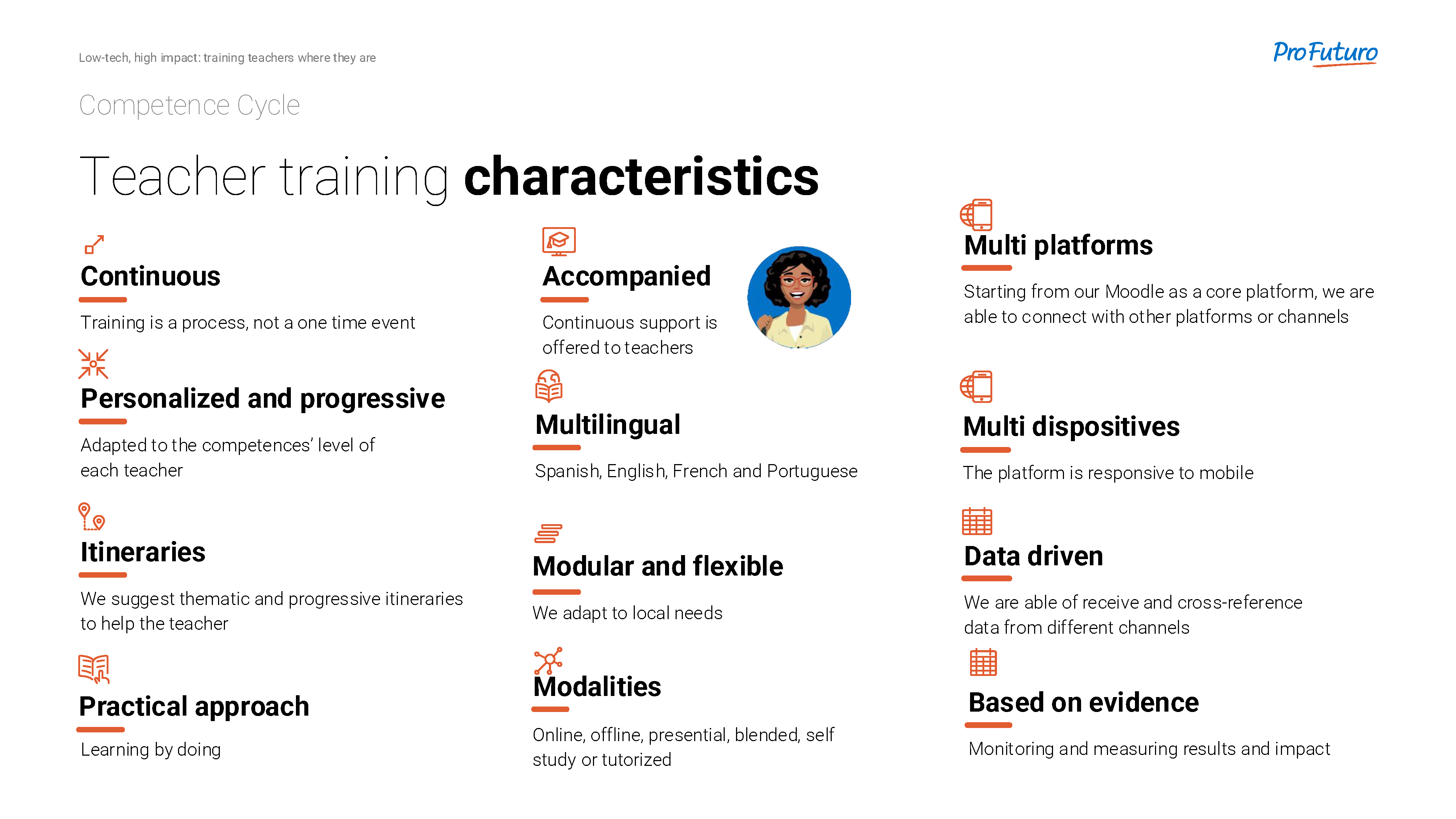
Through implementing their solutions with 1.8 million teachers in 30 countries, ProFuturo has identified a number of key lessons. Educational change is a cultural and systemic process centered on teachers, making their training essential for improving quality. This focus on teachers ensures high-quality training delivery, while flexibility and preparedness allow effective responses to diverse situations and challenges.
Recognizing limits and managing expectations, alongside sustaining continuous innovation and strong collaboration, allow organizations like ProFuturo to address the complexity of training teachers across extremely diverse contexts.
“Strategic partnerships enable the sharing of resources and expertise, ensuring that the program is well-supported and aligned with global educational initiatives” - Mila Tonarelli, ProFuturo
Key Takeaways and Next Steps
After the webinar, participants were surveyed to gather perspectives on teacher training strategies and needs in their own contexts. The following common themes emerged:
- Teachers of the future will need to be digitally fluent, adaptable lifelong learners who foster student well-being, communicate effectively, and navigate evolving pedagogical and technological landscapes.
- Key teacher training challenges include limited funding and infrastructure; inequitable access to training opportunities, particularly in rural areas; and an overfocus on pre-service training with a lack of ongoing, relevant, and inclusive professional development.
- Successful teacher training strategies encompass peer and community-based learning; flexible digital and hybrid formats; hands-on coaching; and practical, learner-centered approaches that promote collaboration and continuous growth. Necessary conditions for effective training partnerships include a shared vision and trust, mutual commitment with aligned goals, and empowered and actively engaged local teams.
Based on the discussion, it’s clear that this is a common priority. There is a need for low-tech and mobile teacher training and ongoing professional development across all education systems. This initial webinar and blog are the start of a series of professional conversations in which the Teacher Task Force members dive deeper into the challenges, solutions, and best practices.
Additional Resources
Future Teacher Kit
- Future Teacher Kit Video
- Future Teacher Kit One-pager
- Future Teacher Kit Implementation Guidelines
- Future Teacher Kit in Ecuador
- Superstar Teacher Toolbox, which is being incorporated into the Future Teacher Kit
- UNICEF Global Learning Innovation Hub
ProFuturo
- Summary of recent ProFuturo findings
- ProFuturo Self-Assessment of Digital Competences
- ProFuturo Self-Assessment of Digital Competences - Technical Note
- Learning pathways: School of Digital Competence
- ProFuturo Platform
- ProFuturo Observatory
- Global Framework for Educational Competence in the Digital Era
Hero photo credit: BMZ, GIZ, UNESCO, UNICEF.